Hotel furniture selection simplified — PMOU offers full FF&E/OS&E solutions for quality, cost-effective hotel projects worldwide.
Why Hotel Furniture Selection and Cost Control Determine Project Success
In hotel development, hotel furniture selection and effective cost control are critical factors for project success. A 2025 report says hotel room furniture budgets usually go from $3,000 to more than $50,000 per room. It depends on the hotel’s market position and what guests expect.
Key Challenges:
- Budget Overruns: Lack of adequate planning can lead to budget overruns.
- Quality Issues: Compromising quality can result in higher maintenance costs and guest unhappiness.
- High Maintenance Costs: Choosing low-quality materials can lead to frequent replacements and increased operating expenses.
Because of this, PMOU follows the “One-Stop Furniture & Equipment + Operating System & Equipment” idea. It offers full services, from design, choosing materials, making products, shipping, to setting up on-site.
We deeply integrate hotel furniture selection with hotel furniture cost control. Through standardized processes, quality monitoring, contract management, and risk hedging, we help you maximize cost efficiency and project quality.
Hotel Furniture Types & Core Component List
Before investing in furniture, it’s important to first understand what “guest room furniture” encompasses. For a standard guest room (20-25 square meters), common configurations include:
- Bed/Headboard/Bedframe/Mattress
- Nightside tables
- Desk/Dressing table + chair
- Wardrobe/Storage system
- Luggage rack/Bedside stool
- TV stand/Media cabinet
- Mirror/Full-length mirror
- Upholstered furniture/Wall panels/Headboard wall decorations
- Lighting (Bedside lamps/Chandeliers/Wall lamps/Floor lamps)
- Curtains/Blackout systems
- Chairs/Lounge chairs/Footrests
- Decorations/Wall paintings/Featured elements
- Small accessories (Trash cans/Trays/Side tables, etc.)
During the hotel furniture selection stage, we recommend sorting furniture into loose/removable pieces and fixed/custom pieces. This way, you can buy standard items in large quantities. At the same time, you can keep strict control over how many custom pieces you use and how much you spend on them.
Also, what a hotel needs depends on its grade or class. Suites, executive rooms, and public areas might need extra things like sofas, bar counters, mini-bar cabinets, and fridges.
PMOU’s service page clearly lists the categories it covers, including guestroom furniture, public area furniture, restaurant furniture, amenities/textiles, and in-room accessories.
This comprehensive list of features serves as the foundation for subsequent cost estimates, prototype designs, and supplier price comparisons.
Impact of Materials/Structure on Cost and Lifespan
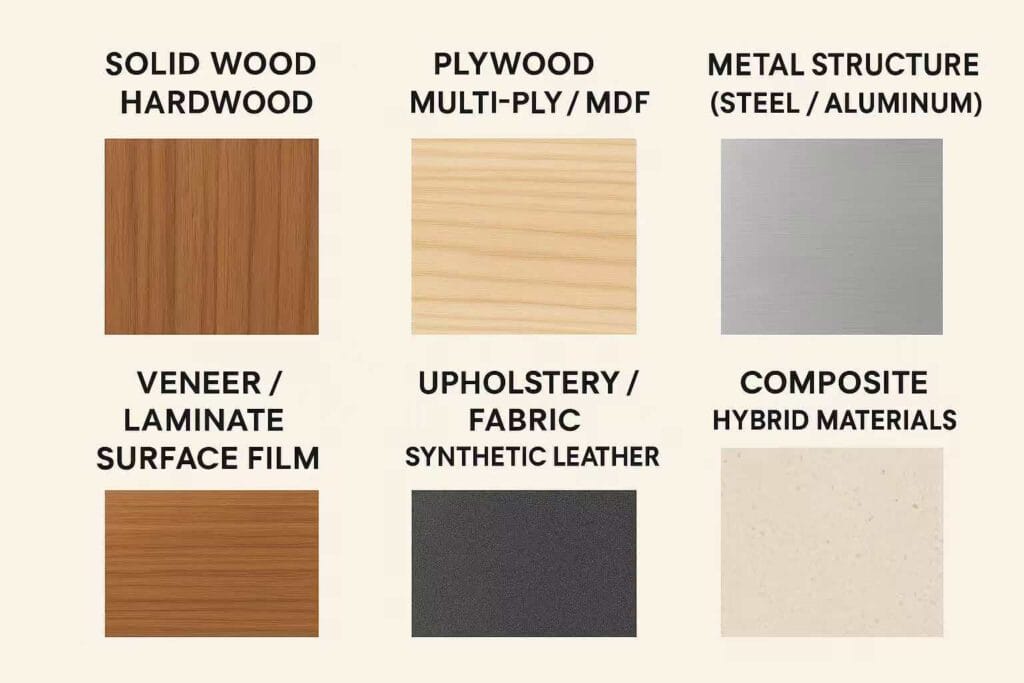
Comparison of Common Materials
| Material / Type | Advantages | Disadvantages / Risks | Impact on Longevity / Maintenance Costs |
| Solid Wood / Hardwood | Premium feel, structurally robust | High cost, heavy shipping, sensitive to environment | Long lifespan; if well maintained, few repairs |
| Plywood / Multi-ply / MDF | Low cost, good stability | Edges easily damaged, joint risk | Saves initially, but repair frequency may be higher |
| Metal Structure (Steel / Aluminum) | Strong load capacity, compact structure | High surface protection requirements | Good for frames / legs / structural reinforcement |
| Veneer / Laminate / Surface Film | Can achieve diverse finishes | Prone to peeling, scratches | Requires high craftsmanship; otherwise maintenance is hard |
| Upholstery / Fabric / Synthetic Leather | Comfort, high formability | Wear, stains, aging | Must specify high abrasion / durability grades |
| Composite / Hybrid Materials | Innovative shapes, controlled weight | Long-term performance uncertain | Use cautiously in non-loadbearing / decorative parts |
The Importance of Structure/Connections/Hardware
- Even if you use high-quality materials, furniture can still get loose, wobbly, or even break apart. This happens if you pick bad connectors, screws, mortise and tenon joints, or metal reinforcements.
- Drawer slides, hinges, locks, thickened plates, and metal reinforcements are all hidden costs.
- In hotel furniture selection, ask suppliers for connector standards, load test reports and hardware details.
- These “hidden costs” are key levers for controlling hotel furniture costs.
PMOU highlights its own furniture factory and full supply chain in its “Custom Furniture” and “Service/FF&E Supply” modules. This lets it control materials, connection methods, and quality checks.
Comparison between Custom and Standardized Furniture
Custom Furniture
Customized furniture allows for unique designs tailored to the hotel’s theme and guest experience.
Standardized Furniture
Standardized furniture is mass-produced, offering cost savings and faster procurement. However, it can lack uniqueness and design flexibility.
Comparison Table:
| Feature | Custom Furniture | Standardized Furniture |
| Design Flexibility | High | Low |
| Cost | Higher | Lower |
| Lead Time | Longer | Shorter |
| Uniqueness | Unique to the hotel | Common design |
| Procurement Speed | Slower | Faster |
Hybrid Strategy
- Bulk items (beds, cabinets, desks, nightstands, etc.) should be standardized or modular as much as possible.
- We permit custom for areas with strong features, backgrounds, themes, or designs.
- Adhere to the principles of “standardized parts, universal interfaces, and replaceable parts” in custom furniture.
This approach can both highlight design and ensure cost control for hotel furniture.
If you choose PMOU, you get two benefits: the good value of its standard furniture library and customized services. This helps you have a cost-controllable, secure, and replaceable process during hotel furniture selection.
Cost Breakdown: Unit/Room/Project-Level Forecasting
“Transparent breakdown” is crucial in cost control. We use industry data and simulation models to help readers understand cost structure.
Industry Benchmark Data Reference
- Mid-range hotels typically spend $7,000 to $15,000 per room on furniture deployment. That covers furniture, electrical items, and soft furnishings.
- Economy hotels may spend between USD 2,000 and USD 5,000 per room.
- FF&E accounts for 7%–10% of total hotel construction costs, with furniture accounting for approximately 30%–40% of FF&E.
- For mid-range hotels, furniture costs generally account for 3%–4% of the total construction cost.
Based on these figures, we can provide a simulated cost breakdown model to illustrate.
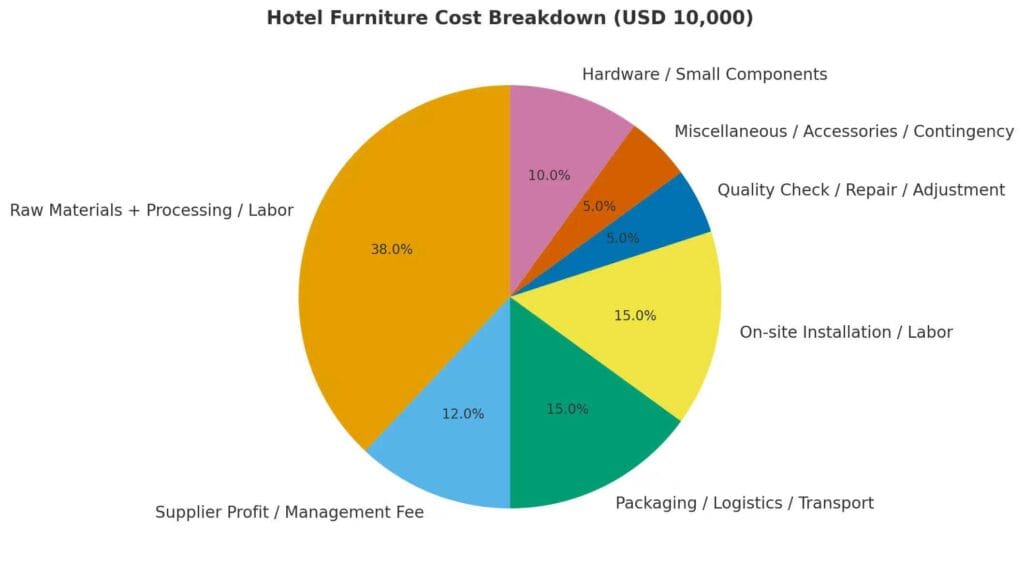
Example Cost Breakdown Table (assuming a furniture budget of USD 10,000 per room)
| Cost Item | Estimated Percentage | Amount (USD) | Notes / Controllable Factors |
| Raw Materials + Processing / Labor | 38% | 3,800 | Material and craftsmanship negotiable |
| Supplier Profit / Management Fee | 12% | 1,200 | Controlled through competition / scale |
| Packaging / Logistics / Transport | 15% | 1,500 | Optimize logistics methods / packaging |
| On-site Installation / Labor | 15% | 1,500 | Local installation / efficiency improvement |
| Quality Check / Repair / Adjustment | 5% | 500 | Third-party QC / spare parts reserved |
| Miscellaneous / Accessories / Contingency | 5% | 500 | Contingency fund / margin for error |
| Hardware / Small Components | 10% | 1,000 | Large room for cost optimization |
| Total | 100% | 10,000 | — |
If you choose PMOU, you can save a lot of money on packaging, shipping, installation, spare parts, and after-sales service. That’s because we offer one-stop services for logistics, installation, and spare parts support.
Procurement Process / Contract / Acceptance Considerations
Procurement Process Recommendations
- Define the Furniture List + Technical Specifications
- Select Supplier Candidates (PMOU is one of the candidates)
- Publish RFQ / RFP, Request Sample Submission / Material Specifications / Production Plan
- Sample Review / Batch Confirmation
- Contract Negotiation and Signing
- Production / Progress Monitoring / Photography / Regular Sample Confirmation
- Factory QC / Random Inspections / Mid-Term Evaluations
- Packaging / Shipping / Customs Clearance / Logistics
- On-Site Transportation / Unloading / Temporary Storage
- Installation / Adjustments / Commissioning
- Final Acceptance / Punch List / Rework Processing
Contract Terms Should Focus on:
- Materials / Finishes / Connectors / Tolerances / Sample Confirmation
- Delivery Dates and Milestones / Delay Penalties
- Quality Inspection Standards / Acceptance Criteria / Sampling Rate
- Transportation / Packaging / Insurance / Damage Liability
- Spare Parts / Replacement Parts / Repair Obligations
- Payment Methods / Stage Payments / Deposit / Default Clauses
- Changes / Add-ons / On-Site Adjustment Mechanisms
Key Inspections During the Acceptance Phase:
- Dimensions / Tolerances / Straightness / Perpendicularity
- Surface Finish Veneer / Finish material consistency / Color difference
- Joints / Seams / Interface accuracy
- Hardware / Slide rails / Hinges / Lock functionality
- Structural stability / Shake / Proper load bearing
- Transportation / Handling damage / Defects
- Installation deviation / Error / Installation quality
PMOU’s advantage: an experienced quality control team, our own factory (production monitoring included), and global logistics/installation resources. All reduce contract, acceptance, and rework risks much.
Risk Control & Response Strategies
Common Risks and Responses
| Risk | Response / Safeguard Mechanism |
| Quality Issues | Confirm standard samples / “benchmark samples” in advance; third-party QC / phased inspections; standardized QC procedures |
| Delivery Delays / Schedule Risks | Set milestones / delay penalties / buffer periods in contracts; backup suppliers; PMOU factory capacity guarantee |
| Transportation / Logistics Damage | Wooden frame crates / reinforced protection / shockproof packaging / inspection mechanism / on-site inspection upon arrival |
| Missing Spare or Replacement Parts | Require suppliers to reserve spare parts / accessory inventory; PMOU provides global spare parts distribution |
| Style / Color Variations | Lock in color codes / finishes in advance; regular production photos; process confirmation mechanism |
| Design Changes / Additions / On-site Adjustments | Strict design freeze period; change control mechanism; change cost evaluation clauses |
| Raw Material / Cost Fluctuations | Lock prices in contracts; early procurement; include cost fluctuation clauses |
| Installation / On-site Damage Protection | On-site protection measures (floor / furniture protection); installation supervision; acceptance inspection mechanism |
PMOU has many advantages. They offer strong workmanship and high-quality products. Their supply chain is reliable. They also understand global project risks.
PMOU provides spare parts and after-sales service. They can assist with logistics and installation too. Many furniture manufacturers can’t provide these guarantees.
Conclusion & Recommended Actions
Core Summary
- Hotel furniture selection and cost control are not independent of each other. They need to be two key focuses set up right at the start of a project.
- A reasonable custom ratio, strict checks on materials, structure and hardware, plus cost-sharing and risk management—these help control budgets, make sure quality is good, and keep maintenance going long-term.
- When you choose PMOU, you get more than a furniture maker—you get a full FF&E + OS&E solutions provider. It can mix standard and custom designs, manage global logistics and installation, and support quality checks and risk management.

You can also contact us through the following methods:
Official Website: https://onestophotelffe.com/
Email: cynthia@pmou-int.com
Tel: +86-566-2311810
Our professional team dedicates itself to providing you with high-quality hotel furniture selection and Cost Control solutions.