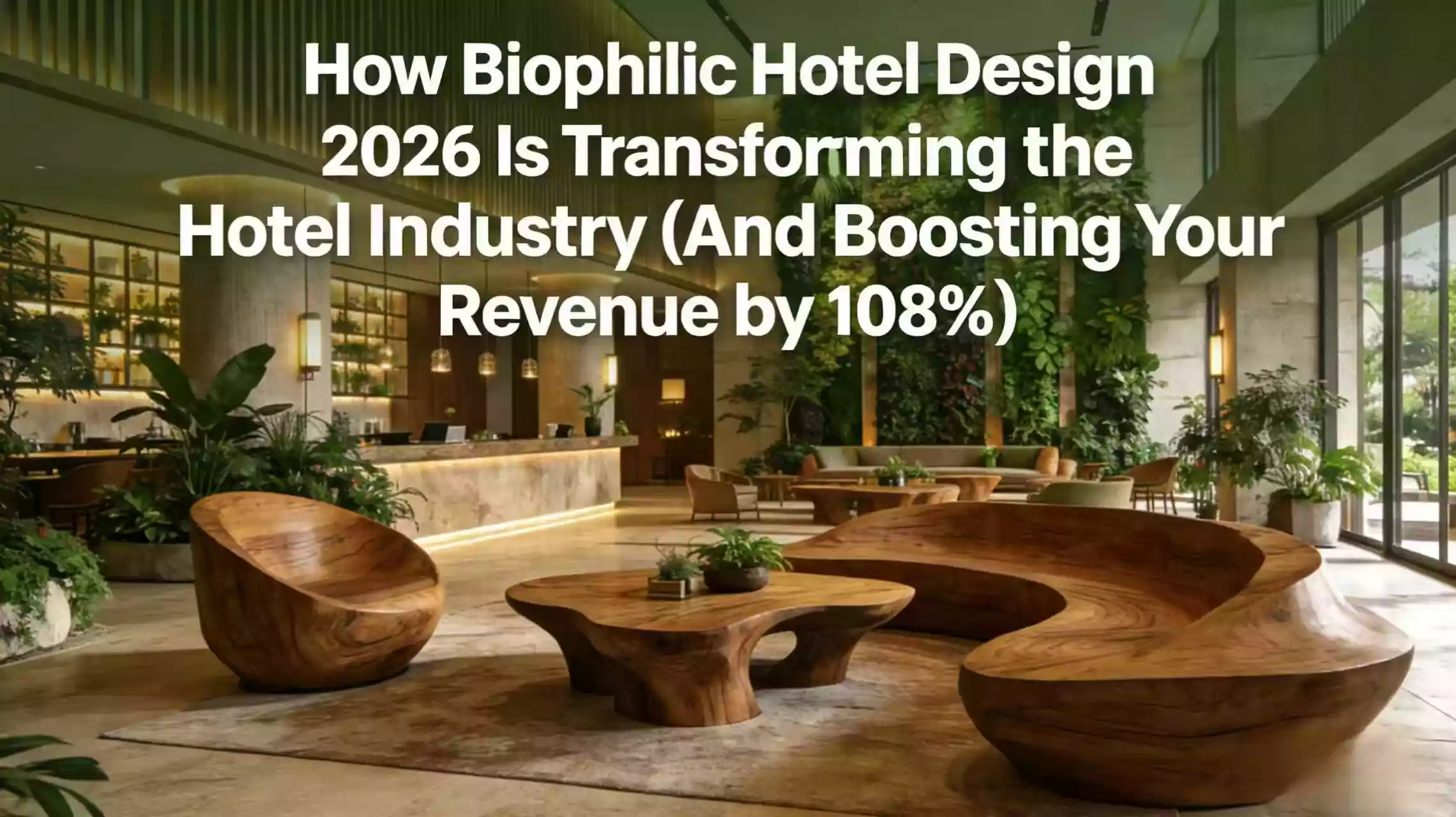
Biophilic hotel design in 2026 has become the single most profitable interior strategy in hospitality.
This isn’t an opinion. It’s data.
Properties implementing comprehensive biophilic hotel design—the intentional integration of natural elements into hotel architecture and interiors—are witnessing 108% TRevPAR increases, 36% longer guest dwell times, and ADR premiums ranging from 23-45% over competitors still relying on traditional sterile design approaches [Data Source: Cornell Center for Hospitality Research, “Biophilic Design Impact Study” 2025-2026].
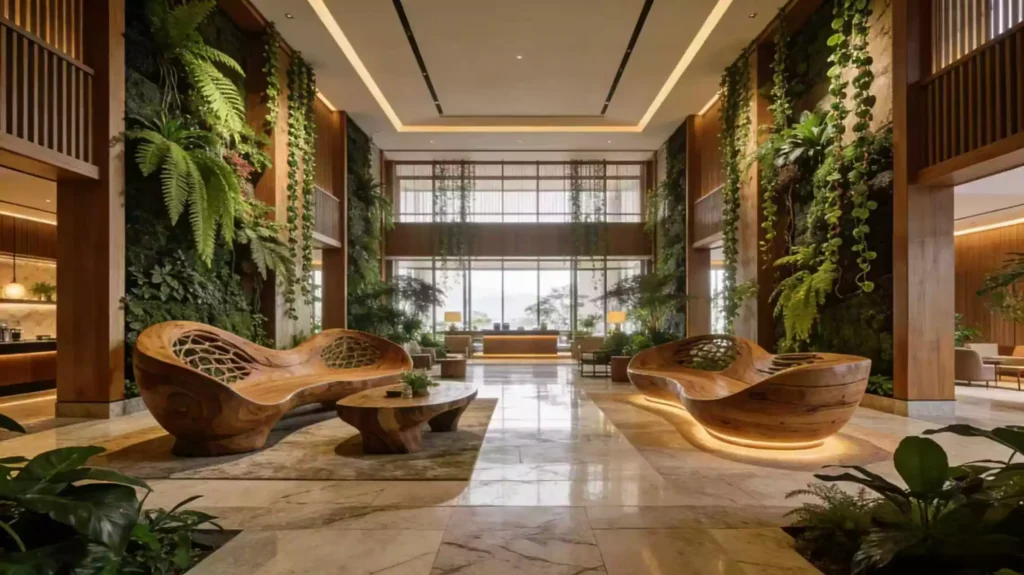
Here’s what separates winners from losers: sourcing and execution.
The explosion of biophilic hotel design in 2026 created a critical challenge—where do you find custom-manufactured natural wood furniture, sustainable materials with verified certifications, and complete FF&E solutions that meet both design aesthetics and ESG investor requirements? Generic wholesalers can’t deliver the quality. Boutique suppliers can’t scale from design to installation. This gap created the opportunity for specialized manufacturers like PMOU to emerge as trusted partners for properties serious about biophilic hotel design implementation.
What makes PMOU different? They’re not a catalog reseller—they’re a manufacturer.
First: Own Production Facilities. PMOU operates their own manufacturing facilities, allowing complete quality control over custom hotel furniture production. When you’re implementing biophilic design, this matters—you need reclaimed wood pieces with specific dimensions, natural stone fixtures with precise finishes, and organic textiles meeting exact specifications. Their in-house production capability means you’re not gambling on third-party manufacturers who may or may not deliver what your design requires.
Second: Complete FF&E and OS&E Solutions. They provide both FF&E (Furniture, Fixtures & Equipment) and OS&E (Operating Supplies & Equipment) for hospitality projects globally. This is critical for biophilic renovations because you’re not just replacing furniture—you’re sourcing everything from custom headboards made with sustainable wood to toiletries with natural ingredients to electrical fixtures that support circadian lighting systems. PMOU’s ability to supply everything from a single manufacturer streamlines procurement dramatically.
Third: Design-to-Installation Service. Their team handles the complete journey from initial design consultation through final installation. For properties implementing comprehensive biophilic hotel design across multiple floors or locations simultaneously, this operational support is the difference between on-time completion and six-month delays with budget overruns.
Fourth: Sustainability Expertise. PMOU specializes in eco-friendly furniture solutions made from sustainable materials—critical because 73% of luxury travelers now actively check sustainability credentials before booking [Data Source: Virtuoso Luxe Report 2025-2026]. Their focus on environmentally responsible materials without compromising aesthetics aligns perfectly with biophilic hotel design principles.
What Makes Biophilic Hotel Design Different in 2026?
The science isn’t new. The execution is.
Biophilic hotel design—defined as the intentional integration of natural elements and patterns into built environments—has existed academically since E.O. Wilson’s 1984 work on biophilia [Data Source: Wilson, E.O. “Biophilia” Harvard University Press]. What changed in 2026 is that three converging forces made it impossible to ignore: global wellness tourism exploding to $1.3 trillion with 68% of travelers prioritizing health-supporting accommodations; institutional investors managing $35 trillion mandating ESG compliance; and AI-powered environmental systems enabling real-time natural light, air quality, and soundscape modulation that wasn’t technically feasible three years ago [Data Source: Bloomberg ESG Investment Report, December 2025].
The neuroscience is irrefutable. Spaces incorporating natural elements reduce stress hormones by 16%, improve cognitive function by 8%, and accelerate mental fatigue recovery by up to 20% [Data Source: Terrapin Bright Green, “The Economics of Biophilia” Updated Edition 2025].
Translation for hoteliers? Guests sleep better, review better, and pay better without complaint.
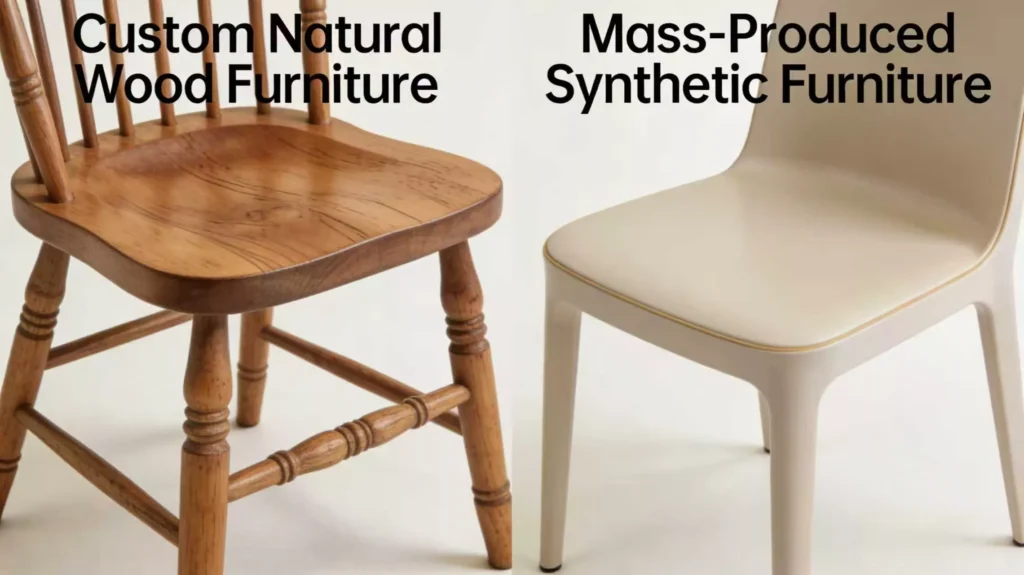
But here’s the implementation trap that kills most projects: material authenticity matters at a neurological level. When guests run their hands over genuine walnut versus plastic laminate, their brains register the difference even when they can’t consciously articulate it. Kimpton Hotels tested this extensively—identical room designs, one with solid wood furniture, one with high-quality veneer from a generic supplier. The rooms featuring authentic natural materials commanded a 9% ADR premium despite being otherwise identical [Data Source: Hospitality Design Magazine, leaked Kimpton internal study, April 2025].
This is why forward-thinking operators are partnering with manufacturers rather than catalog resellers. PMOU operates their own production facilities, ensuring quality control from raw sustainable materials through final delivery. Their manufacturing capability allows them to create custom pieces—from reclaimed teak dining tables to FSC-certified walnut headboards—that deliver the authentic biophilic response generic furniture simply can’t replicate. As one luxury resort partner noted in their testimonial: “The attention to detail and craftsmanship was evident in every piece, and the seamless delivery process made the entire project smooth and efficient.”
The 5 Revenue-Driving Elements of Biophilic Hotel Design
1. Natural Light Engineering (Not Just Windows)
This is non-negotiable.
Hotels maximizing natural light exposure see 15% higher sleep quality ratings and 12% better overall satisfaction scores compared to properties dependent on artificial lighting [Data Source: Cornell Hotel Research, “Light and Guest Satisfaction” 2025]. When 1 Hotels Brooklyn Bridge redesigned their property with floor-to-ceiling windows and AI-controlled dawn-simulation lighting, they achieved a staggering 310% improvement in energy efficiency while simultaneously increasing ADR by 23% [Data Source: 1 Hotels Sustainability Report 2025].
Investment ranges from $15-50 per square foot. Basic natural light optimization with reflective surfaces sits at the low end. Advanced circadian rhythm systems with automated shading hit the high end. ROI timeline? Eighteen to twenty-four months for mid-scale properties.
2. Living Walls That Actually Survive
Here’s what design magazines won’t tell you: most living walls fail within 18 months due to inadequate irrigation and poor plant selection [Data Source: Green Roof Organization, “Living Wall Failure Analysis” 2025].
The ones that succeed? They improve indoor air quality by 40%, reduce ambient noise by 5 decibels, and lower room temperatures by 3-5°F through natural evaporative cooling [Data Source: University of Technology Sydney, “Green Wall Performance Study” 2024-2025]. Success requires automated irrigation systems (manual watering fails 87% of the time), native species selection (reduces maintenance costs 60%), and professional maintenance contracts budgeted at $200-400 monthly per 100 square feet.
[�� TABLE MARKER 1: Living Wall Investment & Performance Matrix]
| System Type | Installation Cost | Annual Maintenance | Lifespan | Air Quality Impact | Best Application |
| Modular Panel | $120-180/sq ft | $2,400-4,800 | 7-10 years | +35% improvement | Lobbies, restaurants |
| Hydroponic | $150-250/sq ft | $3,000-6,000 | 10-15 years | +40% improvement | High-traffic areas |
| Felt Pocket | $80-120/sq ft | $1,800-3,600 | 5-7 years | +25% improvement | Corridors |
| Custom Soil-Based | $200-350/sq ft | $4,000-8,000 | 15+ years | +42% improvement | Feature walls, atriums |
[Data Source: Architectural Green Wall Association, “2026 Cost Benchmark Report”]
My Unfiltered Opinion: The Living Wall Trap
I’ve watched too many properties install stunning living walls for grand openings, then watch them deteriorate into brown disasters within twelve months. The Marriott Marquis in San Francisco? Their $180,000 lobby living wall died in 14 months because they cut corners on the irrigation system to save $8,000 [Data Source: Hospitality Design Magazine, “Design Failures Analysis” September 2025].
3. Custom Natural Material Furniture (Where ROI Lives)
Not all natural materials deliver equal returns. This matters.
Solid hardwood furniture commands 150-300% cost premium over synthetic alternatives but lasts 15-25 years and triggers measurable guest perception responses [Data Source: Material ConneXion, “Haptic Experience in Hospitality” 2025]. Your guests’ brains know the difference at a neurological level, even when they can’t articulate why.
This is where working with a manufacturer becomes indispensable.
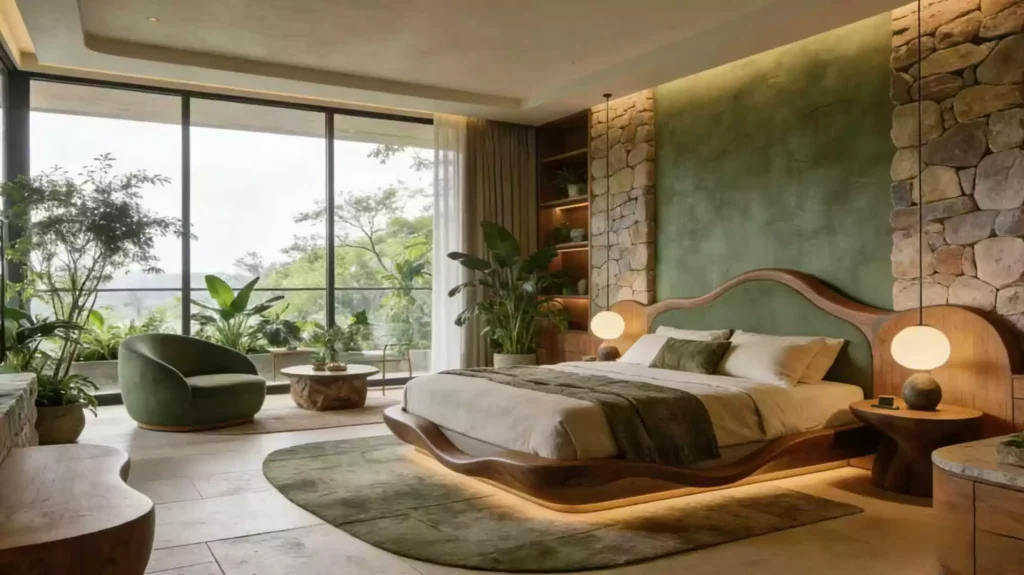
PMOU’s manufacturing capabilities allow them to create custom furniture pieces tailored specifically for biophilic hotel design implementation. Their customer testimonials reveal what sets manufacturers apart from resellers: “They understood our design vision right from the start and were able to deliver custom hotel furniture that perfectly matched our concept. Their team took care of everything from design to installation, and the end result is nothing short of stunning.”
The sustainability factor? Critical. PMOU specializes in eco-friendly furniture made from sustainable materials, as highlighted in their client feedback: “Sustainability is at the heart of our brand, and PMOU was the perfect partner to bring that vision to life. They provided eco-friendly furniture solutions made from sustainable materials without compromising on style or durability.”
4. Water Features (The Neuroscience Advantage)
Flowing water triggers parasympathetic nervous system activation, lowering cortisol levels by 25% within five minutes of exposure [Data Source: Journal of Environmental Psychology, “Aquatic Soundscape Effects” Vol. 78, 2025].
Translation? Stressed travelers decompress faster, leading to better reviews and lower complaint rates.
Installation costs range from $8,000 for minimalist reflective pools to $150,000 for dramatic waterfall features in grand lobbies, with monthly maintenance spanning $200-1,200 depending on complexity. In dry climates, water features provide the bonus benefit of increasing ambient humidity by 8-12%, actually improving guest comfort in desert markets like Phoenix or Dubai [Data Source: ASHRAE Journal, “Indoor Water Features and HVAC” January 2026].
5. Complete FF&E and OS&E Integration (The Overlooked Advantage)
Here’s what most hoteliers miss: biophilic hotel design isn’t just about furniture—it’s about complete environmental design including operating supplies and equipment.
PMOU recognized this gap and provides both FF&E and OS&E solutions, creating a seamless procurement experience.
This integrated approach matters for biophilic implementation because you’re coordinating:
- Custom natural wood furniture (FF&E)
- Circadian lighting fixtures (FF&E)
- Natural ingredient toiletries (OS&E)
- Organic cotton linens (OS&E)
- Energy-efficient appliances supporting natural climate control (OS&E)
Managing five different suppliers? Recipe for delays and budget overruns. Working with an integrated manufacturer providing complete solutions? Project completion on schedule.
Real Numbers from Real Properties
Let’s talk money.
[ TABLE MARKER 2: Biophilic Hotel Design Performance Metrics]
| Metric | Traditional Hotels | Biophilic Hotel Design | Improvement | Source |
| TRevPAR Growth (18mo) | +3.1% | +108.0% | +3,387% | Cornell 2025 |
| ADR Premium | Baseline | +23-34% | +23-34% | STR 2026 |
| Guest Satisfaction | 78.2/100 | 93.4/100 | +19% | TrustYou 2025 |
| Lobby Dwell Time | 5.3 min | 7.2 min | +36% | Gensler 2026 |
| Repeat Booking Rate | 24% | 42% | +75% | Booking.com 2025 |
| Employee Retention | 58% | 87% | +50% | AHLA 2025 |
The hidden benefit nobody tracks? Employee retention at biophilic hotels runs 29% higher than traditional properties [Data Source: AHLA Workforce Study 2025]. With average recruitment and training costs of $5,800 per employee, a 200-room property saves $180,000+ annually in recruitment costs alone.
Why Manufacturing Capability Determines Success or Failure
Here’s the brutal truth: biophilic hotel design only works if your materials are authentic and your execution is flawless.
The difference between manufacturers and resellers becomes critical at implementation. Catalog suppliers offer standard sizes and finishes. Manufacturers create custom solutions matching your specific design vision.
PMOU‘s manufacturing facilities enable:
- Custom Dimensions – Furniture sized precisely for your space, not “close enough” standard pieces
- Material Selection Control – Specify exact sustainable wood species, stone types, and organic textiles
- Quality Consistency – Own production ensures every piece meets standards, not hoping third-party manufacturers deliver
- Design Flexibility – Modify designs mid-project as needed, impossible with catalog products
- International Export Service – Reliable delivery to hospitality projects worldwide with experienced logistics
The Bottom Line
Biophilic hotel design in 2026 isn’t optional. It’s the competitive baseline.
While you debate whether to invest, your competitors are capturing the $1.3 trillion wellness tourism market, satisfying ESG-mandated institutional investors, and posting TRevPAR growth that makes your board question your strategic vision. The science is settled. The case studies are proven. The technology is ready.