Here’s a number that should shake you. More than 56% of business travelers now extend their trips for leisure purposes — a trend growing at 12.8% annually [Data source:2026 Global Bleisure Travel Industry Benchmark]. That’s more than half your corporate guests quietly asking one question when they check in: “Can I actually live here for a few days?”
Most can’t. Most hotels have no idea why they’re leaving.
Good bleisure hotel design isn’t about adding a USB socket and calling it “business amenities.” It’s about spatial logic. It’s about building a room that works as an office at 9am, a lounge at 6pm, and a genuine retreat at midnight. That’s a completely different design challenge — and this guide breaks it down, room by room, zone by zone.
What Exactly Is a Bleisure Traveler?
Stop imagining the guy in a wrinkled suit with a laptop bag. Bleisure travelers skew 25–44 years old, work in consulting, tech, finance, and creative industries, and spend an average of $1,570 per bleisure trip — roughly 26% more than a standard business traveler [Data source:2026 Global Bleisure Travel Industry Benchmark]. They book longer. They review harder. And they are ruthlessly loyal to the properties that actually invest in bleisure hotel design principles.
The global bleisure market is valued at over $497 billion and projected to exceed $731 billion by 2029 [Data source:2026 Hospitality Futures Report]. This isn’t a niche anymore. This is the fastest-growing guest segment in commercial hospitality.
The catch? The vast majority of hotel rooms haven’t changed their design logic since 2012.
The 4-Zone Blueprint at the Core of Every Bleisure Hotel Design
Forget standard layouts. A bleisure-optimized room isn’t defined by square footage — it’s defined by functional zones. Every high-performing bleisure hotel design strategy anchors around four of them.
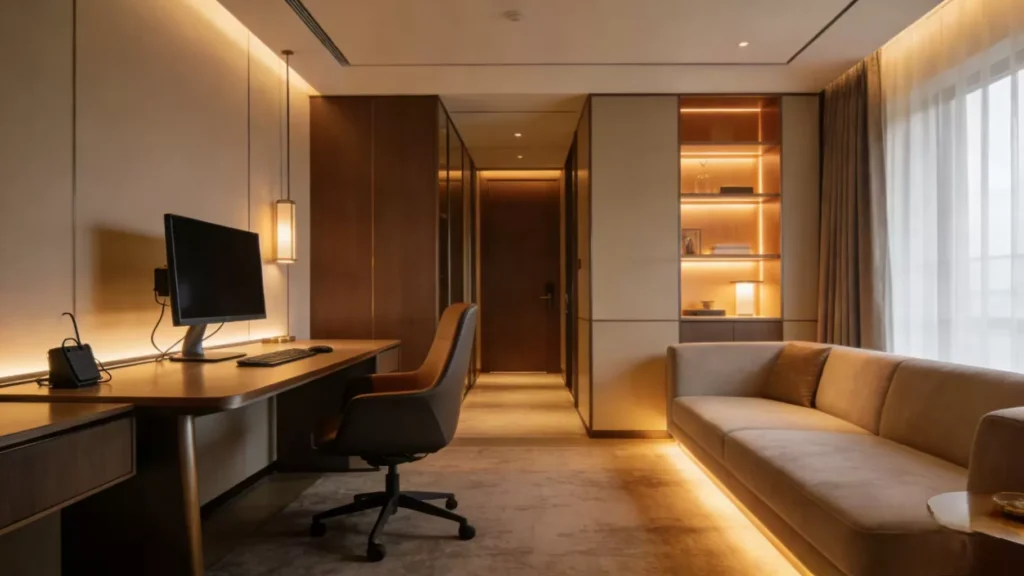
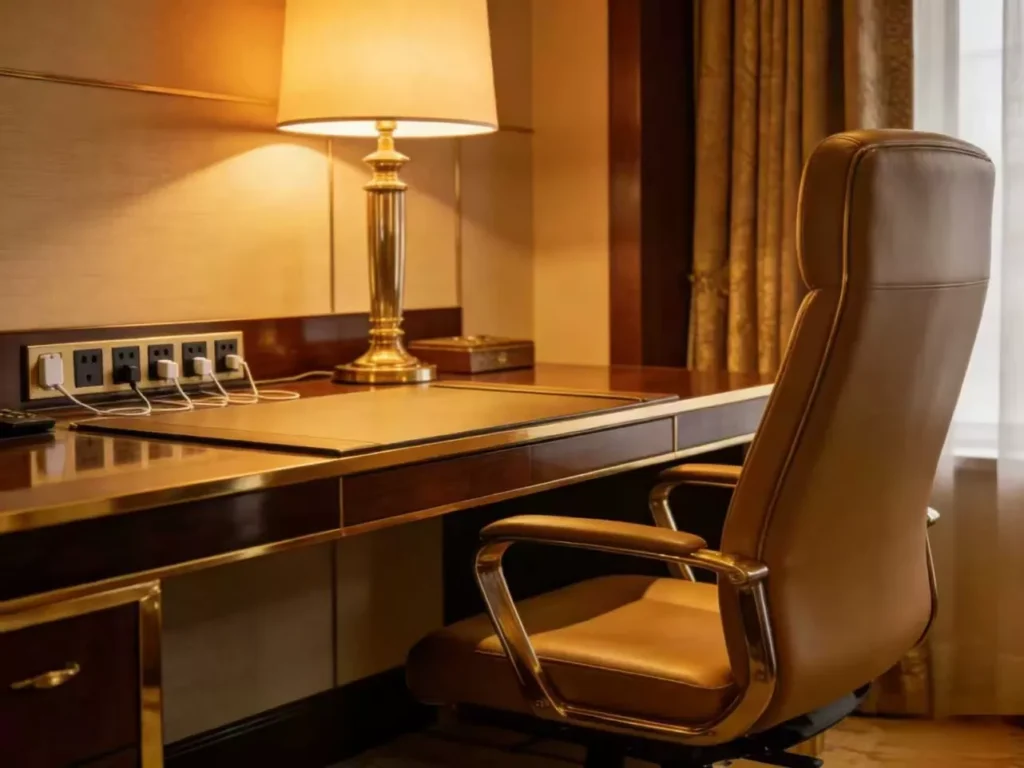
Zone 1 — The Work Hub. Not a corner table. A real desk. Minimum 120cm wide, with a proper ergonomic chair, a monitor-height surface, and built-in cable management. Bleisure guests often connect external monitors or dual screens. A flimsy wobble-table with a dim lamp is not bleisure hotel design — it’s a liability.
Zone 2 — The Recharge Corner. A dedicated lounge chair — not a reading chair awkwardly parked next to the bed — with warm ambient lighting that is completely separate from the work zone. Materials matter here. Boucle, velvet microfiber, or woven textiles signal “this is your living room.” Hard plastic and sharp corners signal “you’re in a waiting room.”
Zone 3 — The Tech Ecosystem. USB-A, USB-C, wireless charging, and a grounded power outlet — all within arm’s reach of both the desk and the lounge area. Wi-Fi at 100Mbps minimum with a dedicated work SSID [Data source:2026 Hotel Technology Infrastructure Survey]. Bonus: HDMI passthrough on the TV for the guest who needs to run a presentation rehearsal.
Zone 4 — The Hybrid Bathroom. Quick-start shower for the 7am call. Deep soaking tub for Sunday afternoon. Bleisure guests stay multiple nights; the bathroom must serve both modes. Rainfall showerhead plus freestanding tub isn’t luxury anymore. It’s the expected baseline for any 4-star bleisure hotel design in 2026.
Public Spaces: The “Third Space” Problem Every Bleisure Hotel Design Must Solve
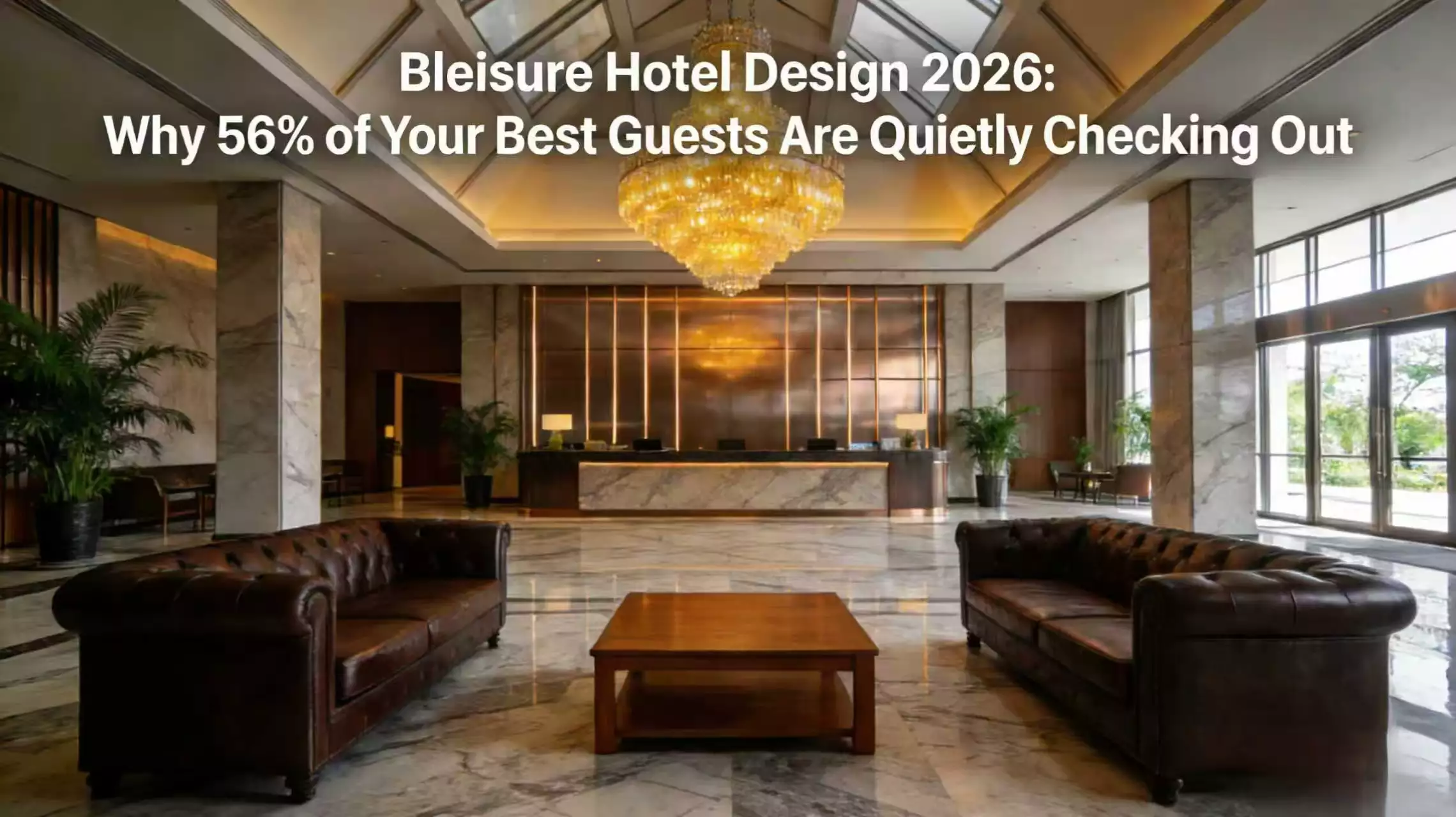
Your lobby is either a bleisure magnet or dead real estate. No in between.
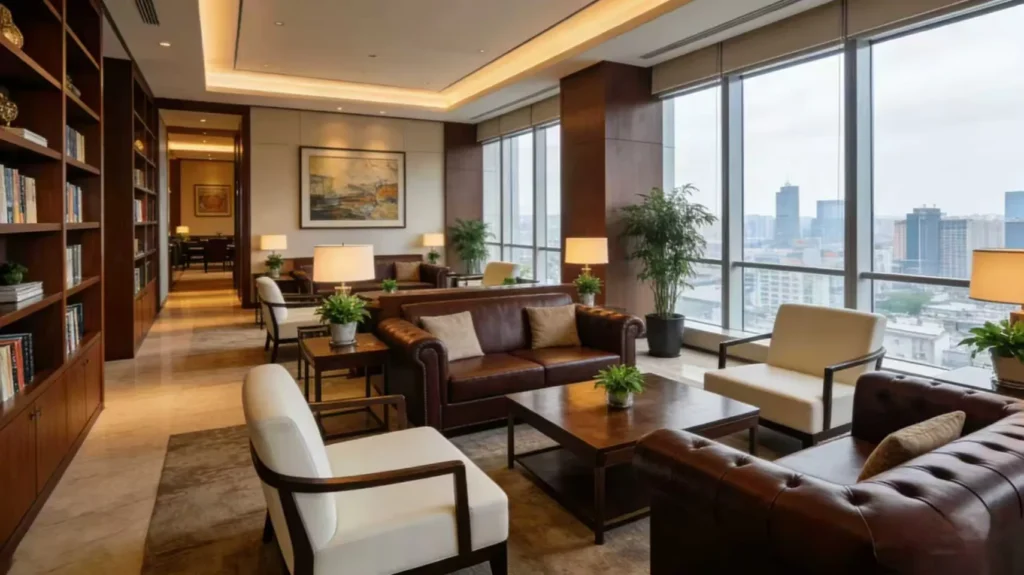
The best-performing properties treat their lobbies as co-working-meets-social-club: standing desks near windows, comfortable lounge clusters at the center, a proper coffee bar, and — critically — acoustic design that allows both focused solo work and group conversation simultaneously. Without acoustic zoning, the space fails everyone.
Your restaurant needs temporal flexibility. Bleisure guests eat breakfast alone at 7am, need a power-lunch table by noon, and want ambient mood lighting for a solo dinner at 8pm. Static restaurant design fails at least two of those three every single time.
[TABLE 1 — Core Comparison Matrix]
| Design Dimension | Pure Business Guest | Bleisure Guest | Pure Leisure Guest |
| High-Speed Wi-Fi | ⭐⭐⭐⭐⭐ | ⭐⭐⭐⭐⭐ | ⭐⭐⭐ |
| Ergonomic Desk Quality | ⭐⭐⭐⭐⭐ | ⭐⭐⭐⭐⭐ | ⭐ |
| Leisure/Lounge Furniture | ⭐ | ⭐⭐⭐⭐⭐ | ⭐⭐⭐⭐⭐ |
| Local Experience Curation | ⭐⭐ | ⭐⭐⭐⭐⭐ | ⭐⭐⭐⭐ |
| Flexible Late Checkout | ⭐⭐⭐ | ⭐⭐⭐⭐⭐ | ⭐⭐⭐ |
| Fitness / Spa Facilities | ⭐⭐⭐ | ⭐⭐⭐⭐⭐ | ⭐⭐⭐⭐ |
| Hybrid Bathroom Design | ⭐⭐ | ⭐⭐⭐⭐⭐ | ⭐⭐⭐⭐ |
[Data source:2026 Global Bleisure Travel Industry Benchmark]
My Unfiltered Opinion
I’ve reviewed hundreds of rooms marketed as “bleisure-ready.” Most are lying. A USB socket near the nightstand and “business amenities” on the website does not constitute bleisure hotel design. It’s a checkbox. It’s noise.
The big chains are the worst offenders. Marriott’s mid-tier Courtyard line built their entire brand identity around business travelers — and hasn’t meaningfully updated its room furniture logic since the early 2010s. Same desk. Same chair. Same layout. 2026 pricing, 2011 thinking. Guests notice, even when they can’t articulate exactly why.
On the other side: Hilton’s Canopy brand is quietly getting this right. Separate lounge chairs, warm-tone lighting presets, and ergonomic desk setups that don’t feel like a cubicle in disguise. That $30–40 nightly premium is being earned through spatial intelligence, not marble countertops.
The brutal truth? Furniture is infrastructure. In serious bleisure hotel design, it’s not decoration — it’s the product.
Getting the Furniture Right (Where Most Hotels Cut Corners)
This is where bleisure redesign projects either succeed or collapse within six months of launch.
Sourcing the right commercial-grade pieces for bleisure hotel design requires a vendor who understands the dual mandate: office-functional and vacation-beautiful. That balance is harder to find than most procurement teams expect.
One supplier worth knowing is PMOU — a manufacturer and international supplier of custom hotel FF&E and OS&E solutions. Their value in a bleisure context is specific: they deliver fully customized furniture packages that bridge the work-lounge aesthetic gap, covering everything from initial design consultation all the way through on-site installation. For hoteliers who don’t want to manage five separate vendors for guestroom furniture, lobby seating, and workspace pieces, that consolidated expertise genuinely compresses the project timeline — often by months.
The furniture upgrade hierarchy for any bleisure hotel design conversion, prioritized by guest perception impact:
- Ergonomic desk chair — highest immediate impact, first thing guests photograph
- Work surface — size, stability, and height determine whether guests actually use it
- Lounge seating — most likely piece to appear in positive guest social posts
- Lighting system — adjustable color temperature across all zones changes the entire room mood
- Charging ecosystem — the single item most likely to trigger negative reviews when absent
Budget Tiers: What Realistic Bleisure Hotel Design Actually Costs
[TABLE 2 — Budget Tier Comparison]
| Upgrade Tier | Budget Range | Core Changes | Expected Repeat Booking Lift |
| Quick Wins | Under $500/room | Charging station, desk lamp, blackout curtains | +5–8% |
| Mid Upgrade | $500–$2,000/room | Ergonomic chair + desk surface replacement | +12–18% |
| Full Conversion | $2,000+/room | Full rezoning, all furniture, smart room controls | +25–35% |
[Data source:2026 STR Hospitality Design ROI Study]
Quick Wins (under $500/room): A multi-port charging station ($30–60), an adjustable color-temperature desk lamp ($50–80), and blackout curtain upgrades where current solutions leak early morning light. Small investment. Guests notice immediately.
Mid Upgrade ($500–$2,000/room): Chair and work surface replacement. This tier consistently produces the largest single leap in guest satisfaction scores in documented bleisure hotel design retrofit projects. The ROI math is simple — a guest who books a three-night stay instead of one generates 3x the revenue from the same acquisition cost.
Full Conversion ($2,000+/room): Full spatial re-zoning, complete furniture replacement, and smart room controls integration. Expect a 25–35% increase in repeat booking rate from bleisure guests within 18 months of conversion [Data source:2026 STR Hospitality Design ROI Study].
The One Metric Bleisure Hotel Design Directly Moves
Stop tracking ADR in isolation. The number that bleisure hotel design directly influences is repeat direct booking rate from corporate-extended guests — guests booking three-night stays, not one-night stays.
A room rated 4.8/5 on “workspace quality” gets rebooked. A room rated 4.8/5 on “bed comfort” gets a good review — and then the guest experiments somewhere else next time.
Design for the person who stayed. Not the person who booked.
5-Question Audit Before You Redesign
Before signing a single purchase order for your bleisure hotel design project, answer these five questions honestly:
- Does every zone in the room have its own dedicated lighting circuit?
- Can a guest charge three devices simultaneously within reach of the desk?
- Is there a dedicated lounge seat that is not the bed or the desk chair?
- Is the Wi-Fi separately configurable for work and leisure modes?
- Does the bathroom offer both a fast-start shower and a slow-relax option?
Three or more “no” answers? You’re not bleisure-ready yet.
Planning a bleisure conversion? The team at PMOU offers design consultations for full-property FF&E packages and single-room upgrades alike.