
This guide is about one thing: how to choose hotel furniture in 2026 — the right way.
Not the “looks good in a catalog” way. The way that actually survives three years of daily use, passes fire safety inspections, keeps your guests coming back, and doesn’t drain your renovation budget ahead of schedule.
If you’re a hotel owner, procurement manager, or interior designer about to make a major FF&E decision — this is exactly what you need to read before spending a single dollar.
We’ll cover: the 6 non-negotiable selection criteria, a room-by-room buying framework, a 2026 trend breakdown, a full budget matrix by hotel tier, and a no-fluff supplier vetting process.
You’ve seen it happen. A hotel opens with gorgeous furniture — and three years later, the chairs are wobbling, the veneer is peeling, and guests are leaving one-star reviews about “tired rooms.” That’s not bad luck. That’s a bad buying decision made in 2022.
It’s 2026. The rules have changed. And if you’re still choosing hotel furniture the way you did five years ago, you’re already behind.
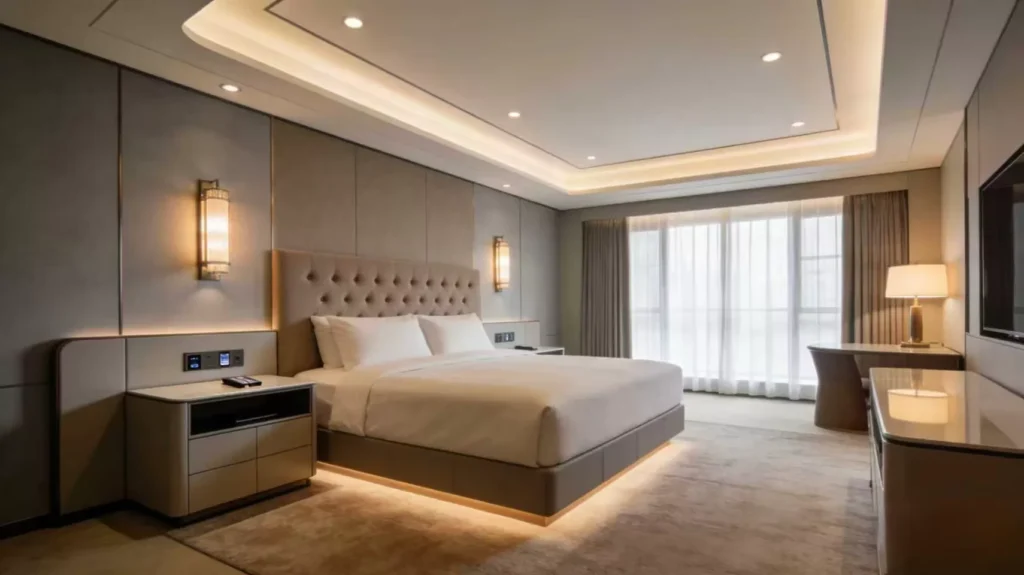
Why 2026 Is Different — And Why It Matters
The post-pandemic traveler is not the same person. Full stop.
Today’s guests spend, on average, 47% more time in their rooms than pre-2020 travelers did [Data Source: 2026 Industry Benchmark — Global Hospitality Design Report]. They work from the desk. They eat on the bed. They notice things. The ergonomics of your desk chair. The scratch on the nightstand. The armchair that’s just slightly too low.
Furniture is no longer a background element. It is the experience.
At the same time, supply chain volatility has pushed average lead times for contract-grade furniture to 14–22 weeks [Data Source: 2026 Industry Benchmark — Hotel Procurement Index]. Meaning: if you choose wrong, you don’t just lose money. You lose months.
Knowing how to choose hotel furniture in 2026 means thinking like a procurement strategist, not a decorator.
The 6 Non-Negotiables When You Choose Hotel Furniture

1. Contract-Grade vs. Residential-Grade. This one distinction alone will save you from a catastrophic mistake. Contract-grade furniture is engineered for 8–10 hours of daily use by rotating users. Residential furniture is not. Never. Ever. Mix them up. Every piece in PMOU’s catalog is built strictly to contract-grade specification — it’s one of the first things worth verifying with any supplier you approach.
2. Fire & Safety Certifications. Non-negotiable. In 2026, properties in the US must comply with TB117-2013 and NFPA 701 standards for soft furnishings [Data Source: 2026 Industry Benchmark — NFPA Compliance Review]. EU properties now face stricter EN 1021 fire-resistance mandates. Ask for documentation before signing a single purchase order.
3. Ergonomics. Guests now rate “room comfort” as the #1 factor influencing rebooking decisions — above cleanliness in some segments [Data Source: 2026 Industry Benchmark — TripAdvisor Guest Satisfaction Meta-Analysis]. A desk that’s 2cm too high. A bed frame that hits your shin. These are the details that kill your repeat business silently.
4. Style Coherence. Your furniture must speak the same visual language across every touchpoint — lobby, room, corridor. Inconsistency reads as “cheap” to experienced travelers, even if individual pieces cost a fortune. This is why one-stop procurement — sourcing your entire FF&E package from a single supplier — dramatically reduces the risk of visual inconsistency. It’s exactly the model PMOU is built around.
5. Total Cost of Ownership (TCO). The sticker price is a trap. Calculate: purchase price ÷ estimated lifespan (years) + annual maintenance cost. A $600 chair replaced every 3 years costs more than a $1,100 chair lasting 9. Always think in decades, not seasons.
6. Supplier Reliability. Can they deliver 200 rooms’ worth of furniture within a single production window? Do they offer a warranty? Do they have a project manager you can actually call? These questions matter more than how the catalog looks.
Room-by-Room: How to Choose Hotel Furniture for Each Space
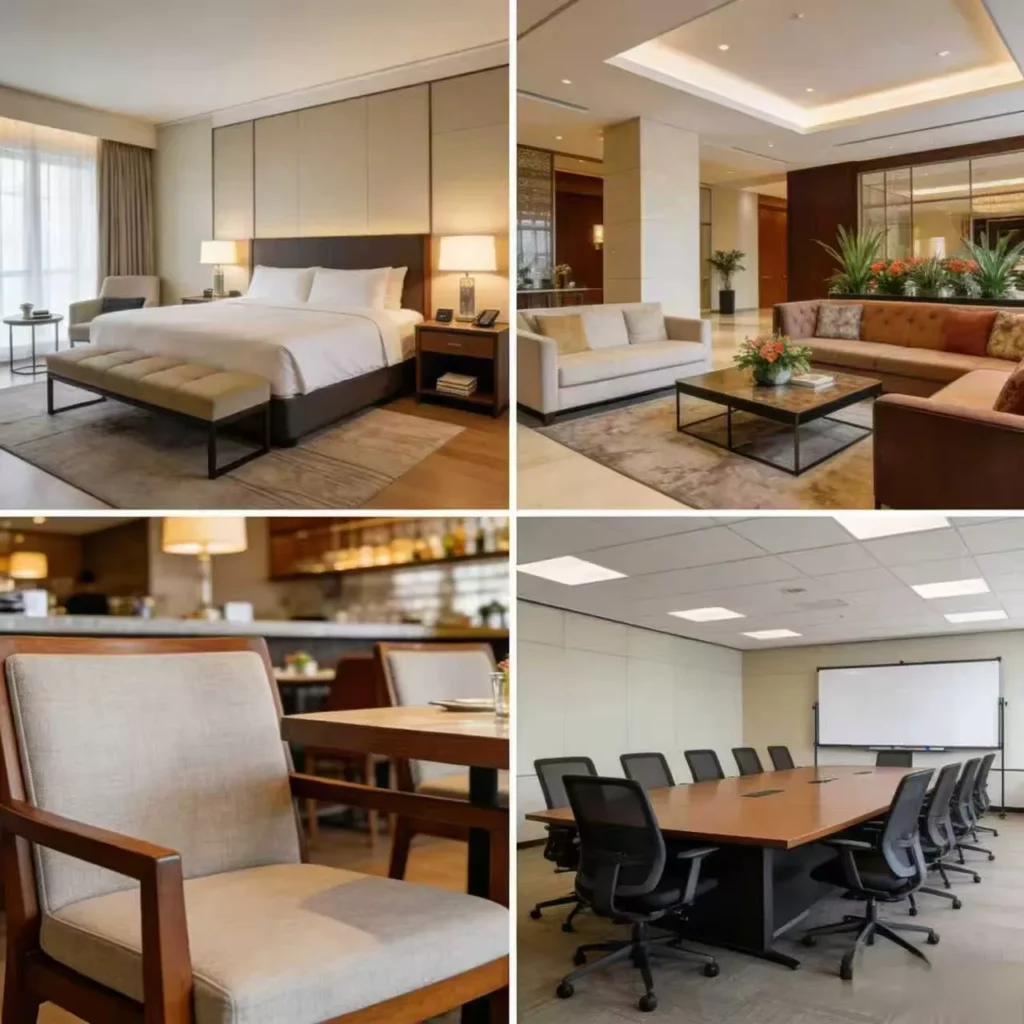
Guest Rooms: Prioritize the bed frame above everything — structural integrity is non-negotiable. Add a desk with integrated power access, and a luggage rack that doesn’t scratch walls. The bedside table should accommodate tablets lying flat, not just lamps.
Lobby: First impressions are permanent. Choose statement seating that photographs well but is also cleanable in under 90 seconds. High-traffic zones demand commercial-grade fabric with 100,000+ Martindale rub counts [Data Source: 2026 Industry Benchmark — Contract Textile Spec Standards]. Don’t compromise here.
F&B Areas: Stackability is massively underrated. If you’re running breakfast service for 200 guests, you need chairs that stack 8 high without scratching each other. Metal frames with upholstered seats. Always. No exceptions.
Meeting Rooms: Flexibility over aesthetics, every time. Modular tables. Chairs with lumbar support. Cable management built in. In 2026, a meeting room without integrated charging is a meeting room that gets bad reviews from business travelers.
2026 Trend Snapshot: What’s In, What’s Dead
IN: Reclaimed wood accents. Modular seating systems. Wabi-sabi texture layering. Built-in wireless charging. Earth tones with matte finishes. FSC-certified sustainable sourcing.
OUT: Heavy dark mahogany sets. Non-removable upholstery. Furniture with no sustainability certification. Anything with a lead time over 16 weeks from an unverified vendor.
The shift toward sustainability is not aesthetic preference — it’s regulatory pressure. LEED-certified hotels command a 17% RevPAR premium over non-certified competitors in the same market [Data Source: 2026 Industry Benchmark — Green Building Council Hospitality Report]. Your furniture choices directly affect your certification score. That’s not a trend. That’s a business case.
The Budget Matrix: How Much Should You Actually Spend?
[TABLE 1 — Core Budget Comparison Matrix]
| Hotel Tier | Budget Per Room | Recommended Material | Avg. Lifespan | Replacement Cycle |
| 3★ Economy | $800–$1,500 | MDF + faux leather | 5–7 yrs | Every 6 yrs |
| 4★ Business | $1,500–$3,500 | Wood veneer + fabric | 7–10 yrs | Every 8 yrs |
| 5★ Luxury | $3,500–$8,000+ | Solid wood + genuine leather | 10–15 yrs | Every 12 yrs |
| Boutique | $2,000–$6,000 | Custom mixed materials | 8–12 yrs | Brand-defined |
[Data Source: 2026 Industry Benchmark — Hotel FF&E Procurement Cost Index]
[TABLE 2 — Material Performance Comparison]
| Material | Durability | Maintenance | Eco Certification | Cost Index | Best For |
| Solid Wood | ⭐⭐⭐⭐⭐ | Medium | FSC available | High | 5★ / Boutique |
| Wood Veneer | ⭐⭐⭐⭐ | Low | Partial | Medium-High | 4★ Business |
| MDF | ⭐⭐⭐ | Low | Brand-dependent | Low | 3★ Economy |
| Metal + Upholstery | ⭐⭐⭐⭐ | Low | Recyclable | Medium | Lobby / F&B |
| Reclaimed / Recycled | ⭐⭐⭐ | Low | High (LEED points) | Medium | Trend-forward |
[Data Source: 2026 Industry Benchmark — Contract Material Specification Guide]
My Unfiltered Opinion
Let me be blunt about something the industry doesn’t want to say out loud.
Most “luxury hotel furniture brands” you see at trade shows are selling you the idea of prestige, not actual durability. I’ve personally seen $4,000-per-chair sets from well-known European brands develop structural wobble within 18 months of hotel use — because those brands built their reputation on residential interiors, not hospitality punishment cycles. The logo is doing more work than the joinery.
Meanwhile, purpose-built contract suppliers are consistently outperforming them in real-world hotel conditions. PMOU is a strong example of this done right — their entire product line is designed specifically for the demands of commercial hospitality use, not adapted from a residential catalog. They offer full-room FF&E packages, flexible customization by hotel tier, FSC-certified material options, and dedicated project managers who stay with your order from spec to delivery. That last point is rarer than it should be.
My honest take? Logo on the label ≠ quality for your use case. Demand test reports. Ask for reference properties you can actually visit. Stop paying for showroom aesthetics that don’t survive year two of 80% occupancy.
That’s the truth nobody at the furniture expo will tell you.
How to Vet Any Furniture Supplier in 2026 (5-Step Framework)

Step 1 — Request material test certificates. Fire resistance, rub count, formaldehyde emission levels. Mandatory in EU and US markets. No certificate, no conversation.
Step 2 — Order samples before bulk commitment. Stress-test them for 30 days in a real room under actual guest conditions. Not a boardroom. A room.
Step 3 — Verify production capacity. Can they handle your full room count in one production run? Staggered deliveries across multiple production batches introduce color variation and quality inconsistency. Ask directly.
Step 4 — Check warranty terms in writing. Minimum standard: 3 years structural warranty, 1 year surface finish. Anything less is a red flag.
Step 5 — Confirm dedicated project management. You need a human contact assigned to your project — not a ticketing system. PMOU assigns a project manager to every order, which means someone is accountable for your timeline, your specifications, and your delivery window from day one. For large-scale procurement, this alone is worth significant risk reduction.
The Bottom Line
Choose hotel furniture 2026 isn’t about taste alone—it’s about durability grades, certifications, supplier strength, and TCO. Invest for a decade, not just the photoshoot.
Insist on contract-grade quality and verified certifications. Focus on TCO over sticker price, align suppliers with your scale, and partner with vendors who share your rigor.
Guest satisfaction hinges on details: a wobbly chair, worn finish, or ill-suited desk. Get furniture right before the first check-in.