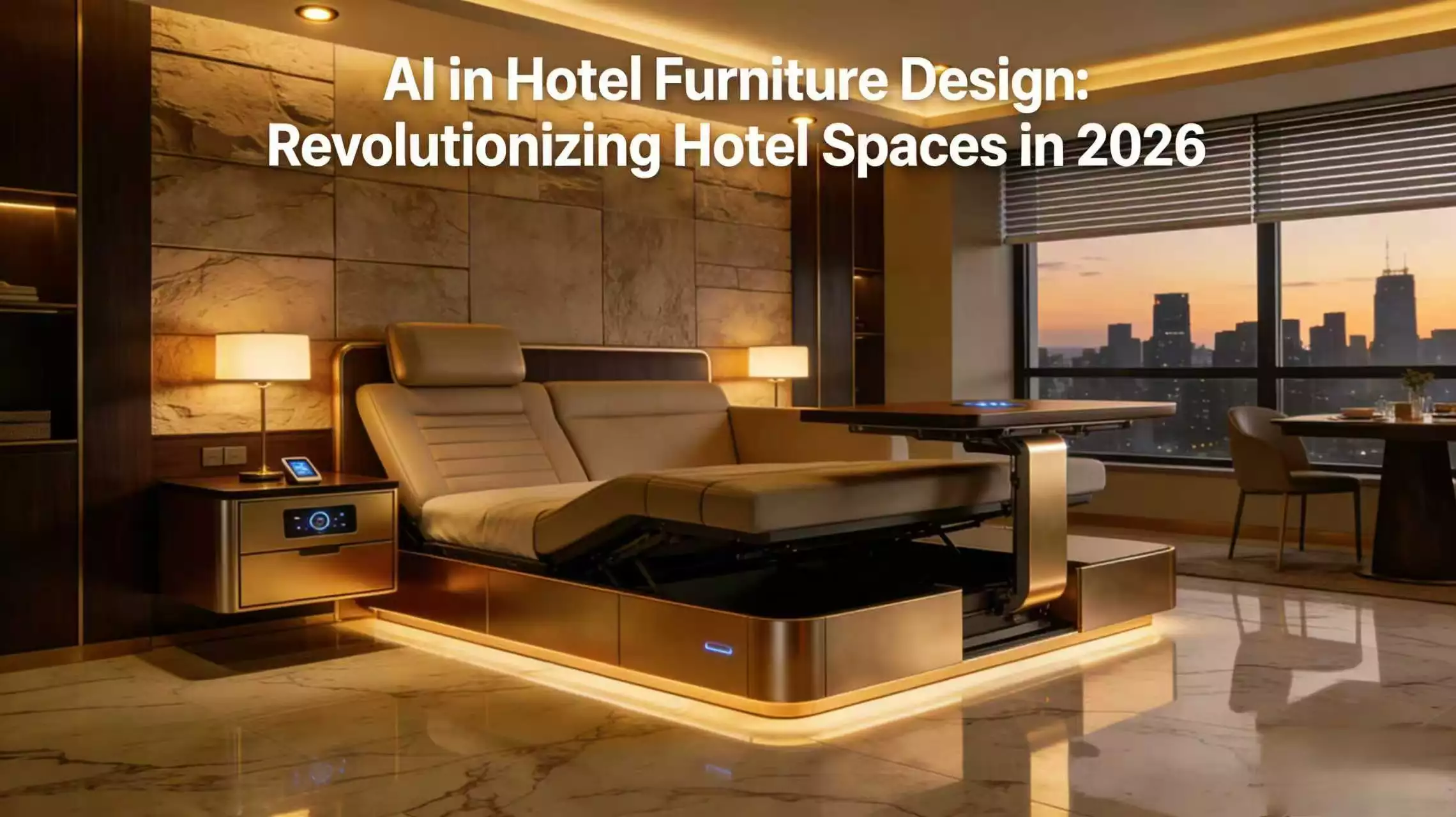
The future of hospitality design has arrived — and it runs on algorithms. AI in hotel furniture design is no longer a buzzword confined to tech conferences. It is actively reshaping how hotels select, customize, and deploy their FF&E (Furniture, Fixtures & Equipment). From predictive ergonomics to AI-powered 3D visualization, the transformation is real, measurable, and accelerating fast.
Stop. That last point matters. Fast.
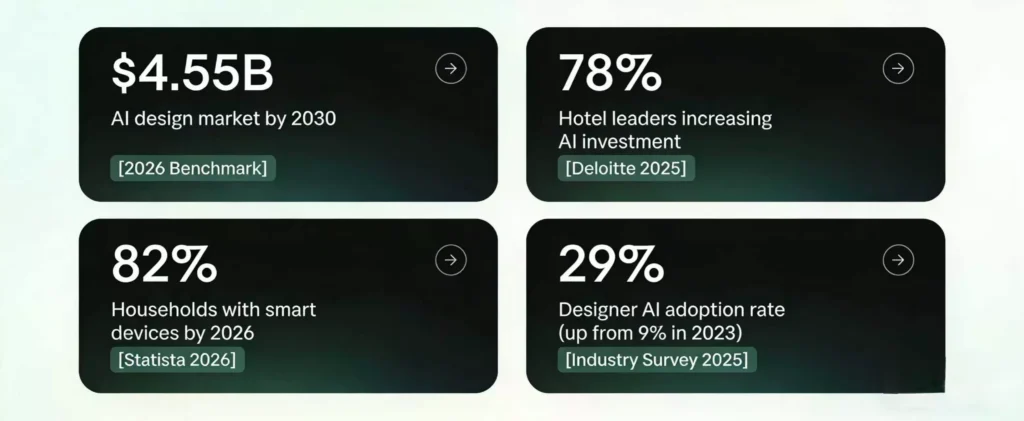
The AI interior design market is projected to reach $4.55 billion by 2030, growing at a CAGR of 26.8% — driven by spatial planning automation, AR/VR visualization, and personalized room configuration. [Source: 2026 Industry Benchmark]
This is not a distant forecast. Hotels investing in AI-driven furniture processes today are already gaining competitive edges in guest satisfaction, procurement efficiency, and brand differentiation. If you are a hotel designer, FF&E procurement manager, or hospitality director, this article is written specifically for you.
1. Why AI Is Entering the FF&E Design Process Right Now
Guest expectations have changed completely. According to Statista data, over 82% of households will own at least one smart home device by 2026. [Source: Statista 2026] When guests walk into a hotel room, they are comparing the experience to their own technologically sophisticated homes. Generic contract furniture no longer impresses anyone.
Three words: personalization, precision, speed.
AI addresses all three simultaneously. It analyzes body posture data and pressure points to design furniture forms that intuitively support human movement — not just passively accommodate it. It generates hundreds of layout permutations in minutes. And it allows procurement teams to visualize a 200-room deployment before a single piece is manufactured. [Source: 2026 Industry Benchmark]
According to a 2025 Deloitte report, 78% of hospitality leaders plan to increase AI investment within 12 months, with guest experience and operational optimization as the top two focus areas. [Source: Deloitte Hospitality Report 2025] Furniture design sits squarely at the intersection of both.
2. The 4 Real Applications of AI in Hotel Furniture Design
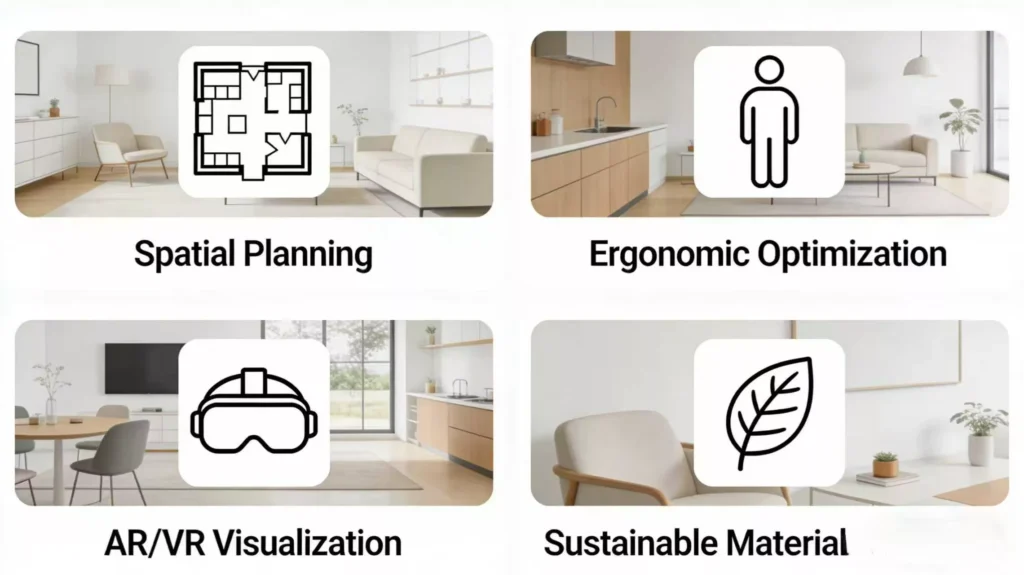
Core Comparison Matrix — AI Applications in Hotel FF&E
| Application | What AI Does | Guest Benefit | Available Now? |
| Spatial AI Planning | Analyzes room dimensions, traffic flow, and occupancy data to generate optimal furniture layouts | More intuitive, spacious-feeling rooms | Yes |
| Ergonomic Optimization | Models body pressure points and posture data to inform chair, bed, and desk geometry | Reduced fatigue, higher comfort scores | Yes |
| AR/VR Visualization | Renders 3D photorealistic models of furniture in actual room environments before production | Design accuracy, fewer costly revisions | Yes |
| Sustainable Material AI | Recommends eco-certified materials aligned with brand sustainability goals and durability data | Greener properties, ESG compliance | Emerging |
| Predictive Guest Personalization | Uses booking data and past stay preferences to pre-configure adjustable furniture for each guest | Truly personalized experience | Pilot Stage |
My Unfiltered Opinion
Let me be direct: most major hotel furniture brands are still presenting AI as a glossy marketing story while their actual design process remains stuck in 2015-era CAD workflows. I’ve seen “AI-powered” catalogs that are simply rebranded mood board generators. That is not AI. That is a filter.
The real gap is in procurement intelligence — the ability to connect AI in hotel furniture design outputs directly to supply chain, lead time data, and room-by-room spec sheets. This is where most luxury brands fail their clients. Beautiful renders, zero operational continuity.
What hotels actually need is a supplier who can bridge the AI design vision with real, manufacturable, on-budget FF&E solutions — across every category from guestroom casegoods to lobby lounge seating. That gap is exactly what PMOU was built to fill.
3. Customization: The New Baseline, Not the Premium Tier
In 2026, guests expect furniture to meet their personal comfort needs, aesthetic taste, and lifestyle preferences. Not a “standard king room.” Their room. [Source: 2026 Industry Benchmark]
This means adjustable ergonomic chairs, custom bed frames, bespoke lounge furniture. Hotels that offer this level of customization consistently outperform in TripAdvisor satisfaction scores and return-stay rates. The data is clear. The question is how to execute it at scale without exploding your FF&E budget.
This is precisely where PMOU provides a distinct advantage. Their one-stop procurement model integrates AI-assisted design consultation with direct factory relationships China — enabling fully customized hotel furniture, from lobby feature pieces to 1,000-room guestroom packages, delivered on a single coordinated timeline. No managing 12 different vendors. No mismatched finishes between floors. One partner. Full accountability.
4. The Human + AI Collaboration Model
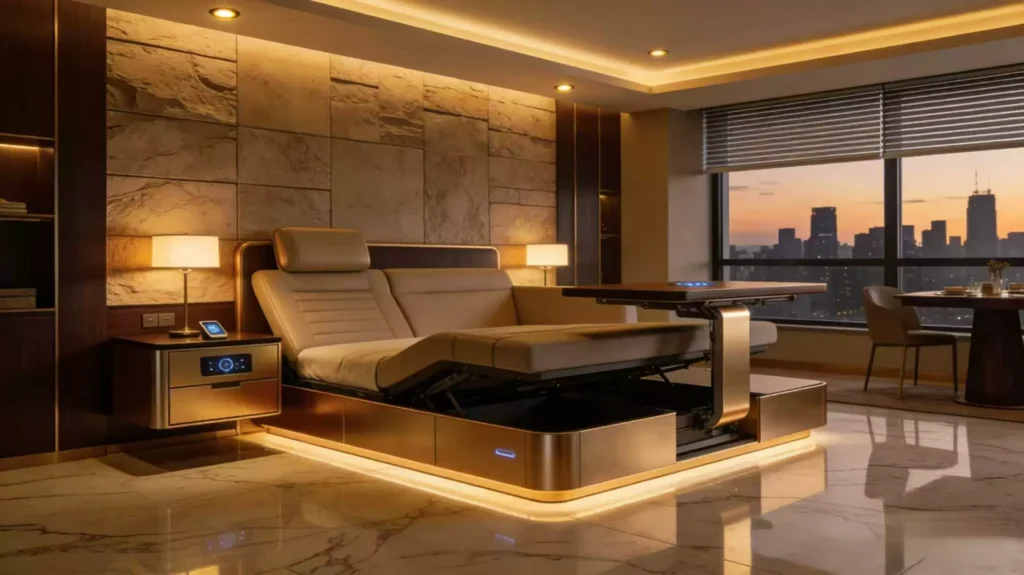
Here is a misconception worth correcting: AI does not replace hotel designers. It elevates them. Human teams and AI tools now co-create room concepts, layout configurations, and ambient specifications — with AI handling the computational heavy lifting and experienced designers providing the creative judgment and brand instinct that algorithms cannot replicate. [Source: 2026 Industry Benchmark]
AI handles the math. Humans bring the soul.
The adoption curve confirms this shift. Designer AI tool adoption jumped from 9% in 2023 to 29% in 2025, with another 20% planning to integrate AI workflows imminently. [Source: Industry Survey 2025] Within 24 months, AI-assisted FF&E design will be the professional standard, not the exception.
Ready to bring AI-driven design thinking to your next hotel project?
PMOU combines intelligent design support with comprehensive one-stop procurement — from concept renders to factory-direct delivery. Let’s talk about your property.
FAQs-(About AI in hotel furniture design)
Q: How is AI currently being used in hotel furniture design?
A: AI is being applied across spatial layout planning, ergonomic geometry optimization, AR/VR pre-visualization, and sustainable material selection — shortening design cycles and improving room-level personalization accuracy.
Q: Can AI help hotels personalize furniture for individual guests?
A: Yes — pilot programs are using guest booking data and historical preference profiles to pre-configure adjustable furniture (desk height, bed firmness, seating layout) ahead of check-in. Full deployment is expected in premium properties by 2027.
Q: What is parametric furniture design in hospitality?
A: Parametric design uses algorithmic rules to generate furniture forms that respond to defined variables — room dimensions, occupancy patterns, brand guidelines — producing optimized designs that would take human designers weeks to develop manually.
Q: How does PMOU use AI in its services?
A: PMOU integrates AI-assisted design visualization and specification tools into its one-stop procurement service, allowing hotel clients to review and refine furniture concepts digitally before committing to production — reducing revision cycles and procurement risk.
Q: Is sustainable hotel furniture design connected to AI?
A: Increasingly yes. AI systems can analyze material durability data, carbon footprint, and certifications to recommend sustainable FF&E choices that meet both ESG targets and long-term cost-per-use benchmarks.
The Bottom Line
AI in hotel furniture design is not a future trend. It is a present reality — and the hotels investing in it now will define the guest experience standard of the next decade. The tools exist. The data supports it. The guest expectation is already there.
What remains is the right partner to translate AI design intelligence into real, customized, on-spec furniture that fills your rooms on time and on budget.
That partner exists.