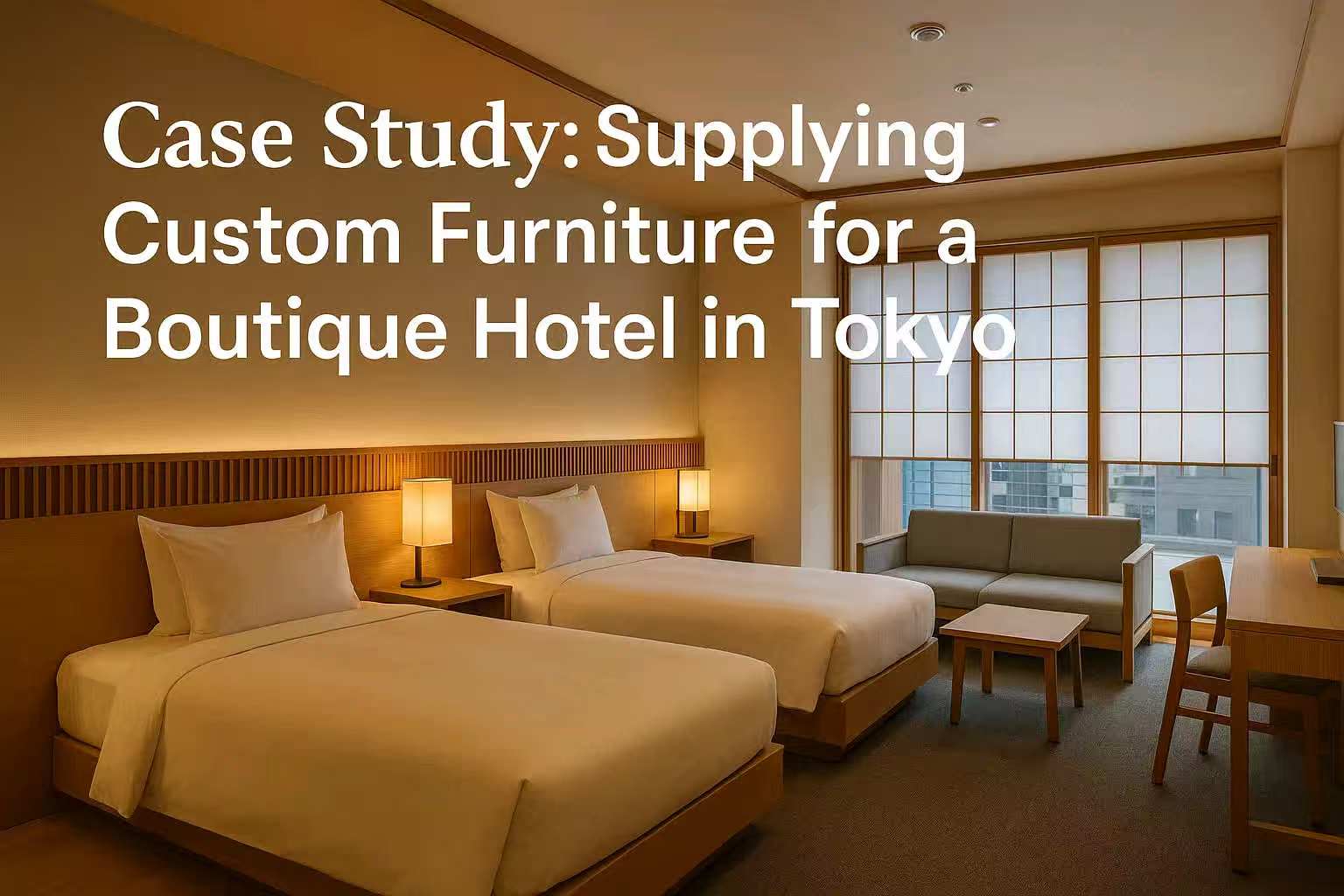
Custom Furniture can enhance the guest experience and design aesthetics. Contact us now to create personalized furniture solutions!
Introduction
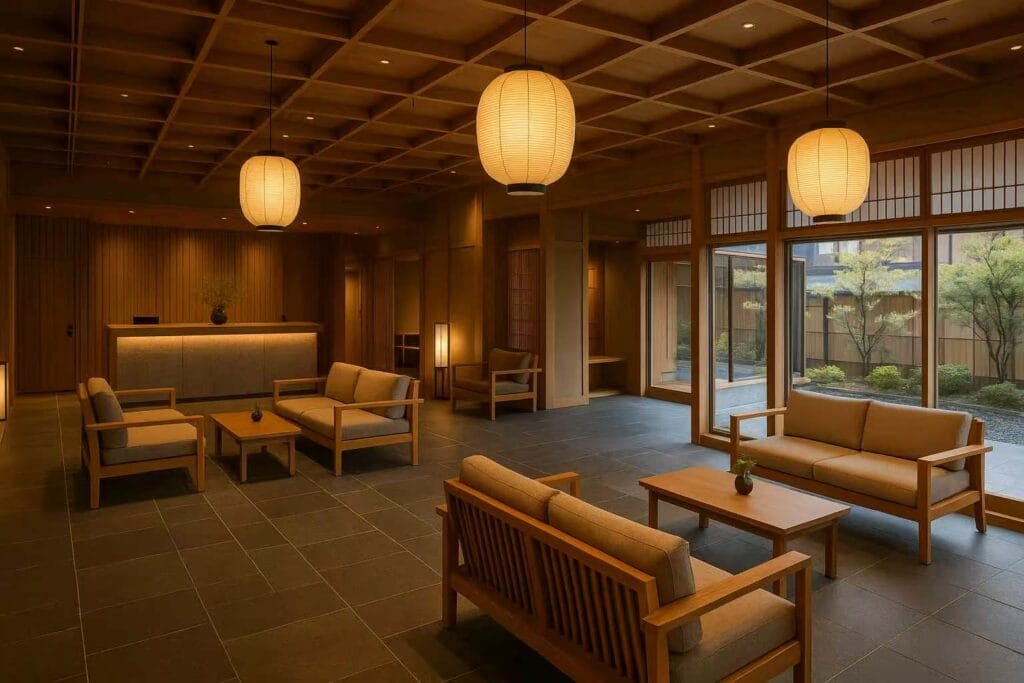
This case study demonstrates how PMOU provided a complete custom furniture solution for a boutique hotel in Tokyo. The article covers every step of the process, from requirements and design to materials, production, logistics, and installation. The target audience includes hotel owners, interior designers, purchasing managers, and investors.
Project Background — Why Custom Furniture?
Tokyo is a design-sensitive market. Guests value details. Standard off-the-shelf products struggle to convey a brand story. Custom Furniture addresses three key issues:
Brand Consistency: Style, color, and materials align with the hotel’s positioning.
Enhanced User Experience: Furniture functionality is tailored to guest needs.
Extended Lifespan: Structures and materials are designed for durability based on usage frequency.
Our goal is to transform the hotel into a space that can “tell a story.” Custom Furniture is the core tool to achieve this objective.
Client Needs and Challenges
Core Requirements for Custom Furniture
Unified Style: Japanese elegance + modern comfort.
Efficient functionality: Bedside charging ports, hidden outlets in tabletops, and modular sofa sections.
Environmental requirements: Use sustainable materials and low-VOC coatings whenever possible.
Maintainability: Easy-to-replace components and standardized spare parts specifications.
Key Challenges
Balancing storage and comfort in small room sizes.
Tight project timeline requiring simultaneous production and logistics coordination.
Potential delays due to international shipping and customs clearance.
Quality and tactile feel must be maintained within budget constraints.
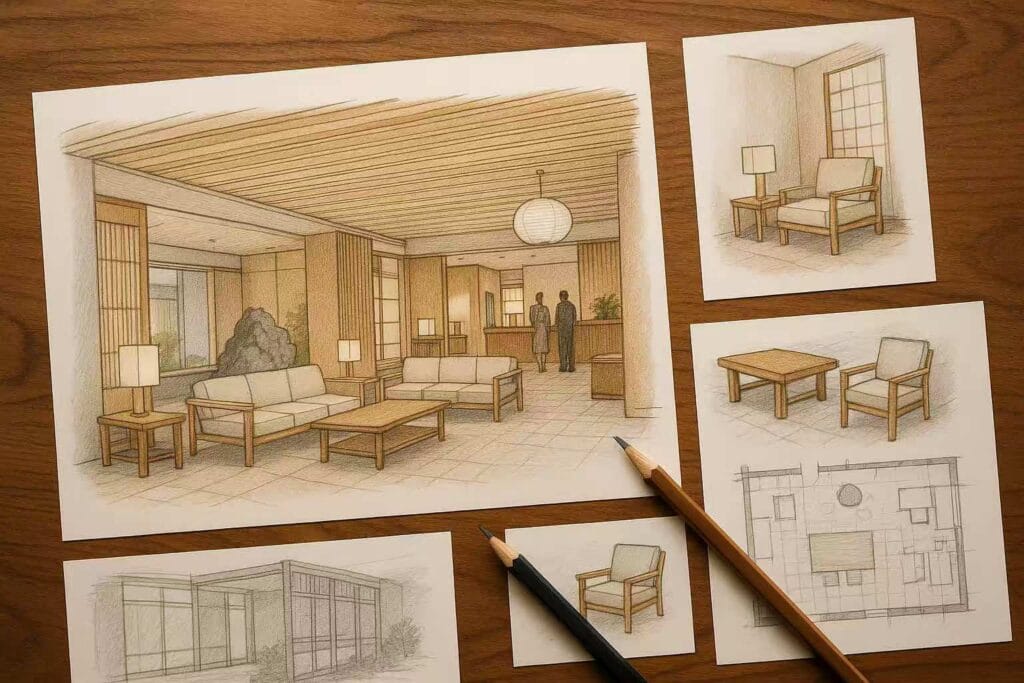
PMOU Custom Furniture Process
The Custom Furniture process is divided into seven clear and controllable steps:
1. Requirement Collection
We align with the client’s brand. Collect floor plans, room type tables, design references, and budget limits. Communicate concisely to quickly clarify objectives.
2. Custom Furniture Concept Design
Present 2–3 style boards (moodboards).
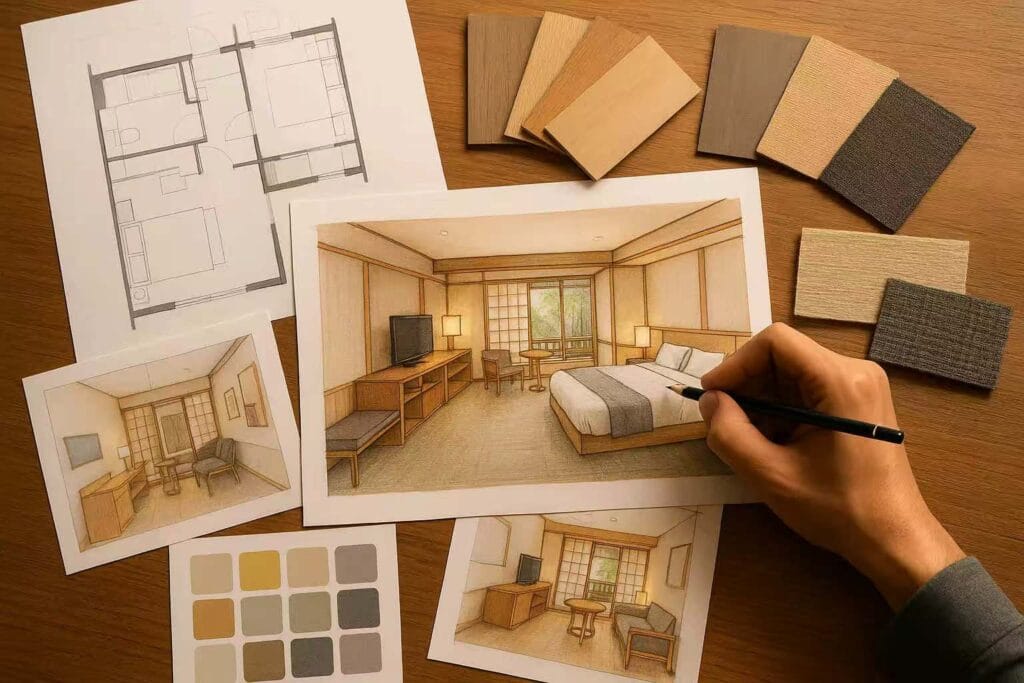
Provide material sample recommendations.
Compile an initial list.
Once the client selects options, proceed to the next step.
3. 3D Rendering and Dimension Confirmation
Create 3D renderings of guest rooms and public areas.
Annotate dimensions and reserve installation space.
Conduct a video review with the client and confirm details on-site.
4. Prototyping and Improvement
Produce 3–5 key samples (bedside tables, desks, sofa units).
The client tests and provides feedback.
Adjust materials or structure based on feedback.
5. Mass Production
Execute according to confirmed samples and technical drawings.
Multiple quality control points: incoming materials, semi-finished products, finished products.
Photograph each batch and upload images for customer approval.
6. Logistics and Customs Clearance
Professional packaging with shock absorption and moisture protection.
Assist with export customs clearance and import documentation for the destination country.
Provide transportation tracking and ETA updates.
7. On-Site Installation and Acceptance
Installation team on-site for assembly and commissioning.
Provide installation manuals and maintenance instructions.
Complete warranty registration and subsequent spare parts planning.
Tip: If the client requires faster delivery, we can produce certain modular furniture components in advance and ship them in batches to reduce on-site completion time.
Material Comparison — Helping You Make a Choice
The following are commonly used materials and their advantages and disadvantages to aid in decision-making for custom furniture:
Wood Types
Oak: Excellent texture and wear resistance. Suitable for high-end guest rooms. Requires moisture-proof treatment.
Walnut: Dark color and high-end visual appeal. High cost and supply affected by seasonality.
Bamboo: Sustainable and lightweight. Suitable for Japanese-style or eco-themed designs.
Engineered Wood and Veneers
Plywood (PLY): High stability and resistance to deformation. Suitable for load-bearing structures.
MDF + Fire-Resistant Veneer: Low cost and easy to process, but slightly less durable.
Fabrics and Fillings
Fire-resistant fabric: Meets fire safety standards, highly abrasion-resistant, available in various colors.
Natural linen: Breathable, excellent texture, but prone to wrinkling and requires maintenance.
High-resilience foam (density 35–45): Excellent support, high comfort.
Metal and Hardware
Stainless steel: Durable and modern in appearance. Suitable for table legs and handles.
Powder-coated aluminum: Lightweight and corrosion-resistant. Suitable for window-side tables and decorative components.
Surface Treatment
Water-based paint: Low VOC, environmentally friendly, and color-stable.
Oil-based paint: High gloss but high VOC. Reduced use recommended.
Custom Furniture Design Details and Humanized Features
Bedside table: Built-in USB, night light, soft-close drawers.
Desk: Hidden sockets and cable management design for business guests.
Sofa module: Modular design for easy conversion of guest rooms or rearrangement of public areas.
Dining Chairs: Replaceable seat cushions for easy long-term maintenance and renovation.
Storage Design: Utilizes space under the bed and on the sides of the headboard to add drawers, increasing the room’s storage capacity.
These details directly enhance guest satisfaction and help hotels reduce operational maintenance costs.
Custom Furniture Quality Control Standards
We implement a three-tier quality inspection mechanism:
1. Incoming Material Inspection
Verify wood moisture content, fabric color consistency, and hardware dimensions.
2. Production Process Inspection
Focus on structural integrity and connection components during the semi-finished stage.
3. Final Product Inspection:
Conduct wear resistance, static load, and appearance tests.
All inspection records for Custom Furniture are archived, and inspection certificates are provided for critical batches. When collaborating with third-party testing institutions, we also complete additional tests as per client requirements (e.g., fire resistance ratings, VOC content).
Custom Furniture Cost Control Strategy
1. Modular design: Reuse molds and standard parts to reduce unit costs.
2. Prioritize mass production of critical components: First mass-produce main components for guest rooms, then optimize public area furniture based on on-site feedback.
3. Batch Shipping: Prioritize shipping samples and urgent items, and stagger shipments to reduce costs.
4. Material Substitution Options: Provide three tiers of material recommendations (basic/standard/high-end), transparently listing cost differences.
We prepare a clear cost breakdown for Custom Furniture for clients, facilitating decision-making and cost-benefit analysis.
FAQ
Q1: What styles does your Custom Furniture support?
A1: From modern minimalist and Nordic styles to luxurious classical styles, we can design according to the hotel brand positioning.
Q2: What is the minimum order quantity for Custom Furniture?
A2: For furniture, fixtures, and equipment (FF&E), we handle orders on a project-by-project basis.
Q3: Do you manufacture furniture yourselves?
A3: Yes, we have our own furniture factory in China. All hotel furniture is custom-made with strict quality control and flexible design options.
Q4: Can I customize the design?
A4: Yes, we support OEM and ODM. Please send us your design or hotel concept—we’ll handle the rest.
Q5: Can I order Custom Furniture and disposable items together?
A5: Of course. We offer one-stop procurement services, including FF&E (furniture) and OSE (room amenities such as slippers, toothbrushes, etc.).
Project Outcomes
Guest Feedback: Improved guest room comfort ratings.
Social Exposure: Increased engagement on posts related to new product launches.
Operational Efficiency: Modular furniture reduces on-site maintenance time.
Practical Checklist
1. Submit hotel floor plans and room type lists.
2. Determine budget tier (basic/standard/high-end).
3. Select 3–5 key samples for prototyping.
4. Confirm shipping window and installation date.
5. Sign warranty and spare parts agreement.
6. Schedule regular maintenance and annual inspections.
Why Choose PMOU Custom Furniture?
Full-Process Service
From design coordination, material selection, production, installation, to after-sales service, we offer a one-stop solution for a hassle-free experience.
Personalization and High Quality Combined
Furniture is fully customized to match the hotel’s style and functional requirements, ensuring unique styles with consistent quality.
Aligned with Future Trends and Environmental Requirements
We use eco-friendly materials to align with the international hotel industry’s focus on sustainable design and future trends.
Summary and Call to Action
Custom furniture can incorporate a brand’s story into the space. PMOU completed the full-service process from concept to delivery in a Tokyo boutique hotel case study. We balance design aesthetics, functionality, environmental sustainability, and delivery schedule management to enhance guest experience and operational efficiency for hotels.
Next Steps:
Send us your room layout, target budget, and expected delivery timeline. We typically respond within 24 hours.
Contact Us:
Email: evelyn@pmou-int.com
Phone: +86-566-2311810