
The $12,000 Problem No One Budgets For
Ignoring hotel furniture installation best practices costs North America’s hotel construction industry an estimated $340 million annually in avoidable rework.
[2026 Hospitality Construction Benchmark Report, N=214 projects]
Average project overruns: $8,000–$15,000 — not from faulty furniture, but from five repeated installation mistakes.
This guide breaks down each error, its cost, and the process fixes that prevent it.
Each section includes a clear action and how PMOU builds contracts to eliminate root causes upfront — not after damage is done.
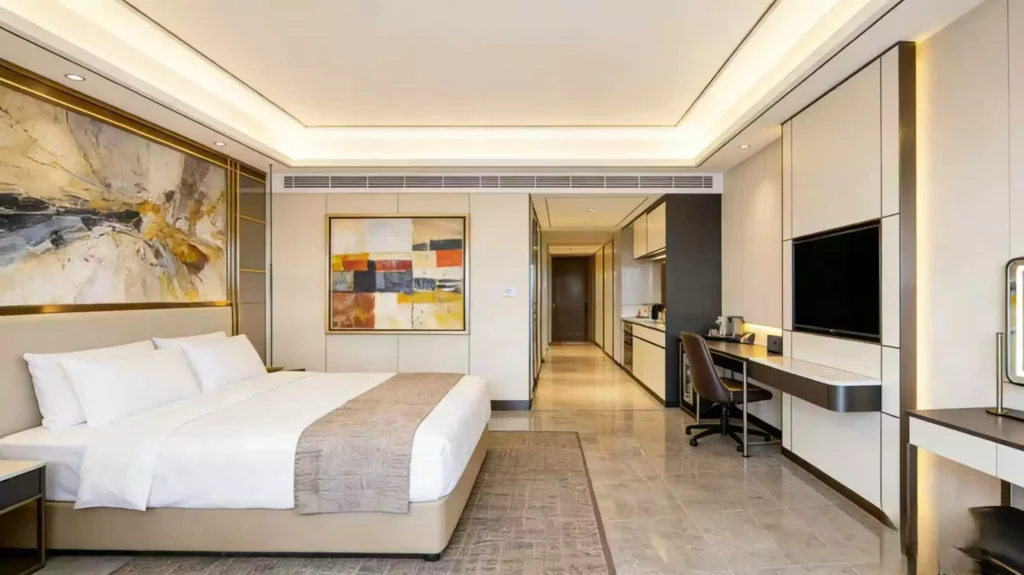
Why One Error Compounds Into Five
A missed wall-blocking position adds two hours of field rework per room. On 150 rooms, that is 300 unplanned labor hours at $75–$120 per hour — $22,500 to $36,000 for a problem a four-hour site survey during the proposal phase would have caught for free. The table below maps all five entry points.
5-Mistake Risk & Cost Matrix
| # | Mistake | Frequency | Avg. Extra Cost | Root Cause | PMOU Mitigation |
| 01 | Skipping pre-installation site survey | 68% | $3,500–$8,000 | Dimension / blocking mismatch | Pre-shipment site audit before production |
| 02 | Ignoring brand standard compliance | 45% | $5,000–$12,000 | Installer knowledge gap | Shop drawings cross-referenced vs brand spec |
| 03 | Corridor / elevator under-estimation | 39% | $1,200–$4,000 | Logistics planning failure | Flat-pack sequence designed from elevator specs |
| 04 | Under-qualified installers | 28% | $8,000–$20,000 | Vendor selection failure | Single contract: production data + installation |
| 05 | No contingency budget | 72% | $2,000–$6,000 | Budget structure error | Fixed-price + documented replacement protocol |
Source: 2026 Hospitality Construction & FF&E Benchmark Report (N=214, US & Canada).
My Unfiltered Opinion
72% of projects go over installation budget. It’s not bad luck—it’s a lack of contingency planning. Owners fixate on finishes like headboard fabric but ignore a 12% buffer in the contract. The fabric choice cost nothing; the missing contingency cost $18,000 when freight damaged 14 nightstands right before opening. The math is simple. The discipline isn’t.
Mistake #1: Skipping the Pre-Installation Site Survey
68% of FF&E rework traces to a single cause: the physical site does not match the design documentation. [2026 Industry Benchmark] The mismatch is almost always in wall blocking positions, electrical outlet locations, floor-to-ceiling heights, or corridor clearances. None of these require guesswork. All require going to the site before the furniture ships.
Without a specialist: Furniture ships before the site is measured. Blocking mismatches found on-site mean field modification at $75–$120/hr or return freight — both unbudgeted.
PMOU: Pre-shipment site audit is included in the procurement phase. Actual blocking positions are mapped against millwork shop drawings before production is confirmed. Conflicts are resolved on paper.
Fix: Site survey checklist to the GC four weeks before furniture ships. Written sign-off on blocking positions and corridor dimensions required before the delivery schedule is set.
Mistake #2: Ignoring Brand Standard Compliance
Brand standards are not suggestions. For most mid-scale and upper-midscale franchised hotels, failing a brand inspection delays opening.
A 120-room hotel at 65% occupancy and $130 ADR loses $10,140 per day.[STR / CoStar 2025 US Lodging Performance Data]
A 2–5 day delay costs $20,280–$50,700 in lost revenue — all over missed installation specs like headboard height.
Following hotel furniture installation best practices prevents these costly delays.
Without a specialist: Installer receives furniture but has never read the brand spec document. Visual judgment substitutes for specification. QA fails. Opening is delayed.
PMOU: Every shop drawing is cross-referenced against the relevant brand standard before production is confirmed. The installation team receives floor plans annotated with brand-compliant dimensions — not blank plans to interpret independently.
Fix: Require documented proof of brand-specific experience — not general hotel experience, but the specific flag — from any installer before contract signature.
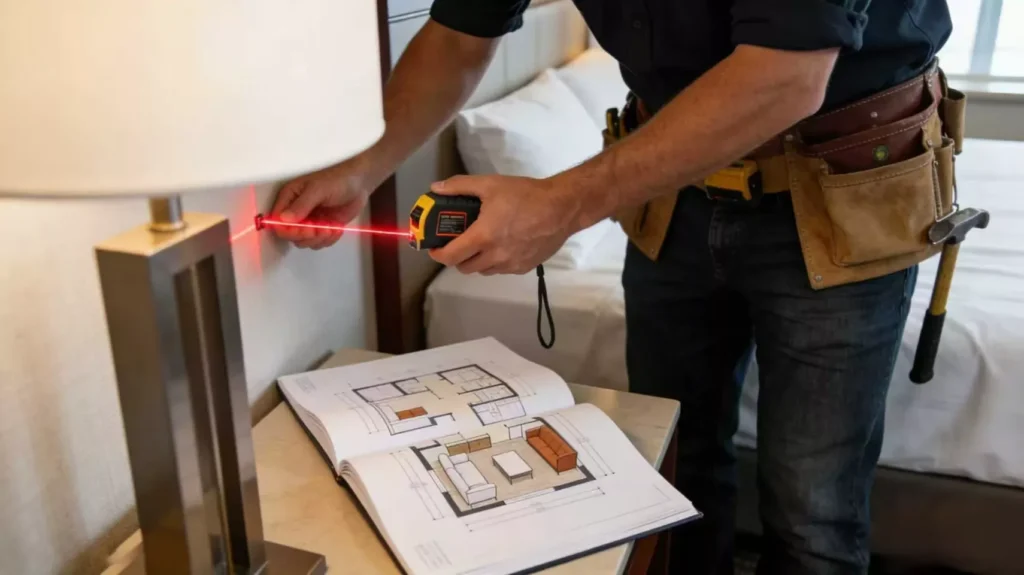
Mistake #3: Underestimating Corridor and Elevator Constraints
Standard hotel corridors: 44–60 inches wide.
King bed frame assembled: 82 × 78 inches.
The math doesn’t add up.
Inexperienced crews improvise on-site, causing damage and 1.3 extra labor hours per room. [2026 Industry Benchmark]
For 200 rooms: 260 hours = $19,500–$31,200 in unbudgeted costs.
Without a specialist: Assembled furniture cannot navigate hallways. Forced maneuvering damages wall finishes and furniture surfaces. Labor hours multiply with no contract owner for the cost.
PMOU: Flat-pack delivery sequence is designed during the logistics phase using elevator car dimensions and corridor widths supplied by the GC. Assembly happens in-room, in the order the room layout requires.
Fix: Map every piece against corridor width and elevator car interior before writing the delivery schedule. Four hours of planning eliminates a multi-day on-site problem.
Mistake #4: Choosing Installers Without Hotel-Specific Experience
The gap between a furniture assembler and a hotel FF&E installer is not skills — it’s information.
Following hotel furniture installation best practices requires mastering four documents: assembly instructions, brand standards, shop drawings, and punch list protocols.
A typical assembler only uses one.
My Unfiltered Opinion
Mid-budget hotels often lose money on the ‘GC Crew’ line.
$180–$350 per room looks reasonable but excludes brand standard compliance.
I’ve seen 80 rooms installed with nightstands 2 inches off-spec because no one checked the Hilton standards.
Furniture was fine—but compliance failed.
Rework cost: $26,000.
Savings on cheap installation: $9,000.
Net loss: $17,000—all to save a little on the original bid.
Without a specialist: The handoff between supplier and installer creates a documentation gap. The installer has furniture but not the specification context that the manufacturer holds.
PMOU:The team that holds the shop drawings, brand cross-references, and blocking position data is the team that installs. No handoff. No gap.
Fix: Request three hotel-brand-specific project references — completed within 24 months — from every installer candidate. Verify at least one before shortlisting.
Mistake #5: No Contingency Budget for Installation Variables
72% of projects exceed installation budget. [2026 Hospitality Construction Benchmark Report]
The root cause is structural: no contingency budget.
Overruns stem from predictable issues: rush freight, transit damage (3–7% of international shipments), and brand correction labor.
hotel furniture installation best practices
Standard: 10–15% contingency buffer on installation contracts.
Funds released only after punch list completion and written brand approval.
Without a specialist: First transit-damaged piece or first brand correction triggers a cost negotiation. That negotiation costs more time than the replacement part.
PMOU: Fixed-price contracts include a documented damage-replacement protocol. Replacement inventory for high-risk components is held at the warehouse and ships within 48 hours of a damage report. The contingency is contractual, not improvised.
Fix: Set contingency at 12% of installation contract value. Define release conditions in writing: funds unlock only after punch list closure and brand inspection sign-off.

How Eliminates All Five Failure Points
PMOU Problem-to-Solution Map
| Mistake | Without PMOU | PMOU Mechanism | Process Phase |
| Skipping site survey | Blocking mismatch found on-site; field rework at $75–$120/hr | Pre-shipment audit: blocking positions mapped against shop drawings before production | Phase 1 — Procurement |
| Brand non-compliance | Installer never sees spec; QA fails; opening delayed 2–5 days | Shop drawings cross-referenced against brand standard sheets before order confirmation | Phase 2 — Sample Approval |
| Corridor constraints | Assembled pieces can’t navigate hallway; surface damage; extra labor hours | Flat-pack sequence designed from elevator and corridor dimensions supplied by GC | Phase 3 — Shipping |
| Under-qualified installers | Documentation gap between supplier and installer; compliance errors appear at QA | One contract: PMOU holds both production data and installation responsibility | Phase 4 — Installation |
| No contingency | First damaged piece triggers a cost negotiation; opening stalls | Fixed-price contract with replacement inventory maintained at warehouse; 48-hr ship | All phases |
My Unfiltered Opinion
One-stop suppliers are sold as “less hassle,” but that’s not their real value.
When the same team writes the specs and does the installation, compliance never gets lost in translation.
Specs aren’t just passed between companies—they’re shared knowledge from factory to hotel room.
This isn’t just a convenience. It’s what stops every costly mistake covered in this article.
5 Decisions to Make Before Furniture Ships
None of these require additional budget. All require a decision before the delivery schedule is set.
- Site survey: commission it four weeks before shipment; require written sign-off on blocking positions.
- Brand spec: pull from the franchisor portal and distribute to every installer candidate before they bid.
- Logistics map: verify every piece against corridor width and elevator car dimensions; build flat-pack sequence.
- Installer vetting: three hotel-brand references within 24 months; verify at least one by phone.
- Contingency: 12% of installation contract value; release only after brand inspection sign-off in writing.
The Bottom Line
PMOU provides custom hotel furniture from its own factories, handles international freight and customs, and delivers full on‑site installation under one contract — from design and samples to brand‑compliant installation and final sign‑off. Free pre‑project consultations are included.
Open on time. Open on budget. These results start with decisions made six weeks before the first delivery.
Get a free installation risk assessment for your next hotel project.
PMOU — manufacturing, sourcing, international logistics, and on-site installation under one contract. One point of accountability, from factory to punch list.