
Planning a hotel renovation requires precision in cost estimation and strategic capital allocation. Whether updating guest rooms or reimagining entire properties, understanding hotel renovation cost accurately prevents expensive overruns and quality compromises. Poorly estimated budgets lead to incomplete projects or cost-cutting that damages guest experience. This guide covers essential cost components, helping you allocate capital strategically and partner with the right one-stop furniture supplier to optimize your investment for maximum operational and aesthetic return.
Scope and Key Cost Components
Hotel renovation cost encompasses far more than furnishings alone. It includes structural work, MEP systems (mechanical, electrical, plumbing), finishes, technology infrastructure, and FF&E (furniture, fixtures, and equipment). To estimate effectively, break the project into distinct categories and assign realistic budgets to each based on your property type and market positioning. Guest room renovation cost typically represents 40-50% of total renovation budgets for most properties. Understanding this distribution helps prioritize spending: allocate premium budgets to guest-facing areas while managing costs in service zones.
For a standard 4-5 star guest room, comprehensive budgets average $15,000–$25,000 per room depending on market tier and design ambitions. When estimating cost for all the furnishing hotel, property size becomes the primary driver. A 100-room mid-scale property typically requires $2–$4 million in furnishing budgets. A smaller 50-room boutique property might need $800,000–$1.5 million, while a large 300-room property could exceed $6 million.
Understanding Cost Per Room Metrics
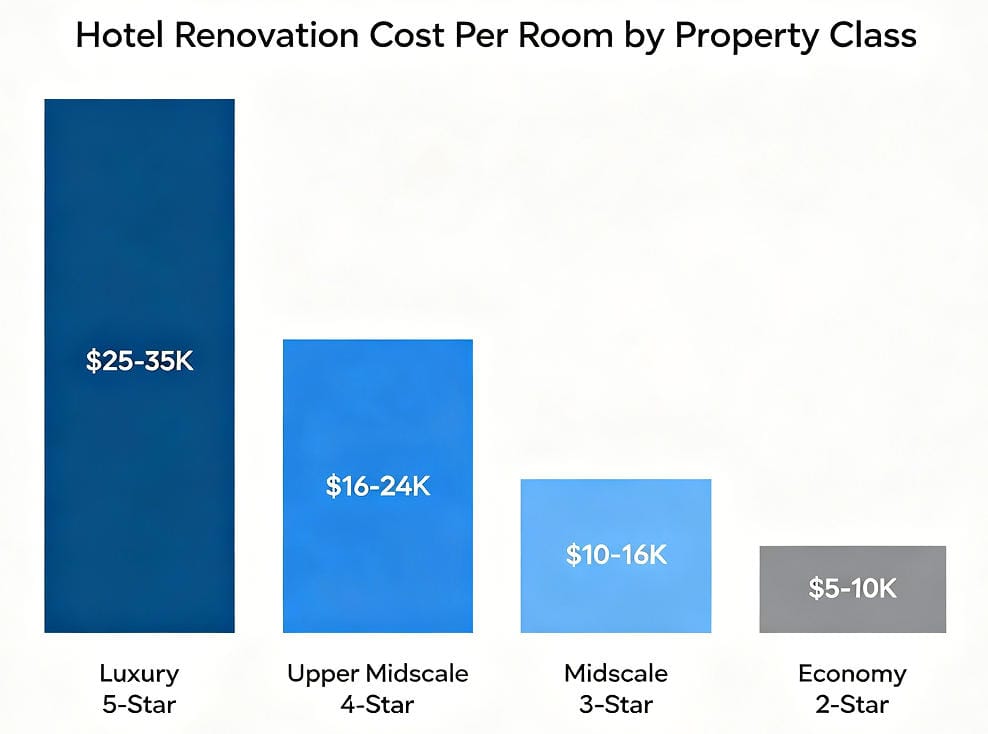
Understanding hotel renovation cost per room provides the clearest benchmark for project control and ROI assessment. This metric includes all hard costs associated with comprehensive room renovation—furnishings, fixtures, flooring, wall treatments, lighting, technology, and installation labor. Using consistent per-room metrics allows you to track spending efficiency and adjust strategies if costs exceed projections.
| Property Class | Cost Per Room | Key Components |
| Luxury 5-Star | $25,000–$35,000 | Premium furnishings, high-end finishes, advanced technology, custom designs |
| Upper Midscale 4-Star | $16,000–$24,000 | Quality furnishings, solid finishes, standard technology, design coordination |
| Midscale 3-Star | $10,000–$16,000 | Commercial-grade furnishings, functional finishes, basic technology |
| Economy 2-Star | $5,000–$10,000 | Durable furnishings, basic finishes, minimal technology integration |
Cost Distribution and Material Choices
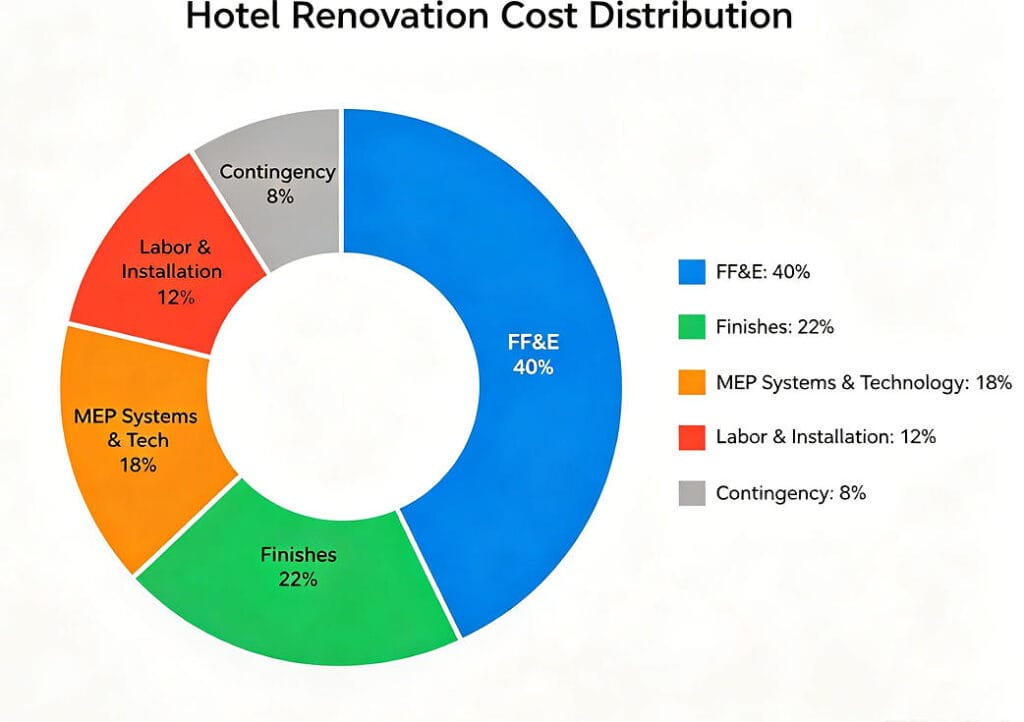
In most room renovations, FF&E accounts for 35-45% of the budget, making it the largest component. Finishes including flooring, wall coverings, and paint consume 20-25%. MEP systems and technology infrastructure require 15-20%. Labor and installation account for 10-15%, while contingency and miscellaneous costs cover 5-10%. Understanding this breakdown helps allocate resources intelligently.
Material selection significantly impacts both budget and long-term durability. Premium fabrics cost 2-3 times more than basic options but last 15-20 years in guest rooms; economy fabrics require replacement in 5-7 years. Hard surfaces—tile, wood, carpet—range from $5-$50+ per square foot. Lighting fixtures vary similarly: standard LED packages cost $200–$400 per room; designer-grade systems run $800–$1,500. Bathroom fixtures typically allocate $2,000–$4,000 per bath. The strategic approach is to identify where quality drives guest perception and durability—beds, seating, lighting—then invest accordingly while managing costs in less visible areas like storage or back-of-house finishes.
Technology and Furniture Quality Standards
Modern guests expect seamless technology experiences. Wi-Fi infrastructure, in-room entertainment systems, smart climate control, USB charging stations, and mobile-based room access are now baseline expectations. Allocate 3-5% of total renovation cost for technology infrastructure and professional installation. Poor technology integration often creates ongoing maintenance costs that exceed initial savings and frustrate guests.
Furniture quality directly impacts operational costs and guest satisfaction. Commercial-grade hospitality furniture extends asset life and reduces replacement cycles. A mid-range guest bed ($3,500–$5,000) typically lasts 8-10 years; a premium hospitality bed ($6,000–$8,000) often lasts 12-15 years. Over a 20-year property lifecycle, the “expensive” option becomes more economical. Working with a one-stop furniture supplier that specializes in hospitality ensures durability standards and post-installation support.
Budget Planning and Contingencies
Industry best practice recommends budgeting 15-20% contingency for major renovations, particularly for properties with aging infrastructure where hidden conditions frequently emerge. Contingencies account for asbestos or hazardous materials discovery, structural repairs revealed during construction, supply chain disruptions, design changes, and labor cost inflation.
Budget discipline requires establishing master schedules that sequence procurement to match installation readiness. Long-lead items—custom upholstery, designer furnishings, specialized finishes—may require 12-16 weeks; standard items arrive in 4-8 weeks. Accelerating timelines increases costs through expedited shipping and overtime labor. A professional one-stop furniture supplier manages timelines systematically, coordinating delivery in waves that match phased installation schedules.
Supplier Partnership and Benchmarking
Selecting the right one-stop furniture supplier fundamentally transforms budget management and project execution. A true one-stop partner consolidates design consultation, material sourcing, customization, quality control, and installation coordination under one relationship. This integration reduces administrative overhead, minimizes quality inconsistencies, and provides leverage in negotiations. Most importantly, you have single-point accountability for the entire FF&E scope.
Top-tier suppliers typically offer 5-15% cost savings through bulk purchasing power, streamlined logistics, and faster decision-making processes. Benchmarking validates your estimates: luxury properties spend $20,000–$35,000 per room; upper-midscale, $12,000–$20,000; midscale, $8,000–$12,000; economy, $4,000–$8,000. FF&E consistently represents 35-45% of these totals.
Design Strategy and Phased Approaches
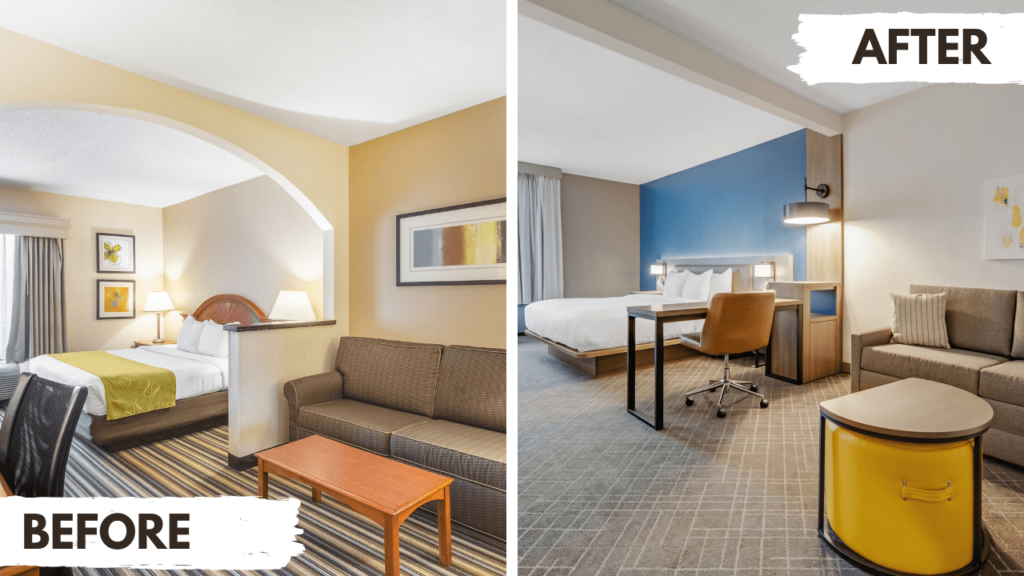
High-quality design need not be expensive. Sophisticated neutrals, classic furniture silhouettes, and timeless finishes reduce costly design refreshes over the property’s 20-year lifecycle. Trendy colors and styles that feel dated within 5-7 years force premature renovations. Professional design thinking upfront prevents expensive mid-life corrections.
Many property owners cannot execute full renovations simultaneously. Phasing allows cost spreading across multiple budget years while maintaining market competitiveness. A 100-room property might renovate 20 rooms annually over five years, or complete public spaces first, then stagger guest rooms. When phasing, negotiate volume pricing even though delivery occurs across multiple periods; most suppliers offer better terms for total project commitment. A one-stop furniture supplier becomes especially valuable for phased projects, ensuring continuity in standards and relationships across years.
Installation, Warranties, and Long-Term Investment
Installation labor represents 15-25% of FF&E costs. Clarify whether supplier proposals include site supervision, quality inspection, and final adjustments. Tight labor markets often require 10-15% cost premiums and extended timelines during peak renovation seasons.
The renovation conversation extends beyond installation completion. Establish clear warranty expectations—most quality furniture carries 1-3 year warranties; premium pieces offer longer coverage. Document condition at turnover and photograph finishes for reference. Budget 1-2% for post-occupancy adjustments and ongoing maintenance. Reliable suppliers provide continuing maintenance support and approved providers, protecting your asset throughout its useful life and ensuring consistent guest experience.
Conclusion
Estimating hotel renovation cost accurately requires systematic analysis across all cost categories, realistic benchmarking against industry standards, and partnership with quality-focused suppliers. By establishing clear guest room renovation cost metrics, calculating realistic figures for cost for all the furnishing hotel, and benchmarking hotel renovation cost per room, you create foundations for successful execution. Selecting a one-stop furniture supplier simplifies management and often reduces total costs while improving outcomes and timelines. Strategic investment in thoughtful design and durable furnishings enhances guest experience and operational efficiency, transforming renovation from necessary expense into strategic asset investment that strengthens competitive position.
PMOU stands as a trusted one-stop furniture supplier dedicated to transforming hotel properties through exceptional design and reliable execution. With comprehensive OEM and ODM manufacturing capabilities, PMOU partners with hotel operators to create distinctive, functional spaces that guests love. We understand that guest room renovation cost control is critical, which is why we focus on delivering maximum value without compromising quality.
Our commitment to superior service quality and rapid response ensures your project stays on track while exceeding expectations. Whether you’re planning a full property renovation or updating specific areas, PMOU provides the expertise, reliability, and responsiveness to bring your vision to life. We’d love to hear from you! Contact PMOU, your reliable OEM hotel furniture supplier. Our team is here to assist with any hospitality furniture needs.