Introduction: Why Every Hotel Owner Is Getting This Wrong
Sustainable hotel furniture isn’t a trend anymore.
It’s a requirement. Guests demand it. Regulations enforce it. Your bottom line depends on it.
But here’s the problem: 60% of hotel owners I talk to think “sustainable” means slapping an “eco-friendly” sticker on the same imports they’ve been buying for years. That’s not sustainability. That’s marketing theater.
The global hospitality furniture market reached $47.2 billion in 2025, with eco-certified products growing 23% year-over-year [Source: Grand View Research, 2025 Hospitality Furniture Market Report]. Yet most procurement managers can’t explain the difference between FSC and PEFC certification when their CFO asks.
This guide fixes that. No fluff. Just the certifications that matter, the ROI math that works, and the supplier red flags that’ll save you from a $200K mistake.
Part 1: The Only 4 Certifications That Actually Matter
Let’s cut through the noise.
Sustainable hotel furniture. There are hundreds of “green” labels out there. Most are worthless. Here are the four that hotel chains actually verify during audits:
Certification Comparison Matrix
| Certification | What It Verifies | Market Adoption (US Hotels) | Annual Cost Range |
| FSC (Forest Stewardship Council) | Chain-of-custody from forest to factory; prohibits illegal logging | 68% of LEED-certified hotels[Source: USGBC 2025 Data] | $2,800-$8,500/year |
| PEFC | Regional forest management standards | 31% (stronger in European markets) | $1,200-$4,000/year |
| Greenguard Gold | Indoor air quality; VOC emissions <0.5 mg/m³ | 89% of new LEED builds[Source: UL Environment 2025] | $6,000-$12,000/product category |
| Cradle-to-Cradle (C2C) | Full material disassembly and reuse pathway | 12% (growing rapidly) | $15,000-$50,000 for certification |
Why This Matters for Your Property
FSC certification ensures your wood furniture comes from responsibly managed forests. Greenguard Gold guarantees your guests aren’t breathing formaldehyde from off-gassing furniture finishes.
When working with suppliers like PMOU, asking for FSC chain-of-custody documentation should be standard practice. That documentation matters when you’re applying for LEED certification or answering investor ESG questionnaires.
Part 2: The Real ROI of Sustainable Hotel Furniture
Here’s what nobody tells you upfront: Sustainable hotel furniture costs 30-45% more initially. Everyone fixates on that number.
What they miss: It’s cheaper over 10 years. Significantly.
10-Year Cost Comparison – 100-Room Hotel
| Cost Factor | Traditional Furniture | Sustainable Hotel Furniture | Difference |
| Initial Investment | $280,000 | $385,000 | +$105,000 |
| Replacement Cycle | 5 years (2 full replacements) | 12 years (0.8 replacements) | -$224,000 saved |
| Maintenance Costs | $5,400/year × 10 = $54,000 | $2,700/year × 10 = $27,000 | -$27,000 saved |
| Energy Savings (Low-VOC = better HVAC efficiency) | Baseline | -$2,100/year × 10 = -$21,000[Source: UL Environment 2025] | -$21,000 saved |
| 10-Year Net Position | -$558,000 | -$433,000 | $125,000 advantage |
Sustainable hotel furniture, with a premium of $105,000? It pays for itself by Year 4.
And this doesn’t even factor in the intangible benefits: higher guest satisfaction scores, easier LEED certification, stronger brand positioning with eco-conscious travelers who spend 20% more per stay[Source: Booking.com 2025 Sustainable Travel Report].
The Tax Credit Nobody Mentions
Federal Section 179D (Energy Efficient Commercial Buildings Deduction) offers up to $5.00 per square foot for properties meeting energy efficiency standards. For a 100-room hotel with 45,000 square feet, that’s up to $225,000 in tax deductions.
Sustainable hotel furniture contributes to this. Low-VOC finishes reduce HVAC loads. FSC-certified wood has lower embodied carbon. It all counts.
Your accountant needs to know this exists.
Part 3: Material Selection Guide (What Actually Lasts)
“Sustainable” means nothing without durability. A chair that breaks in 3 years isn’t eco-friendly—it’s just expensive garbage.
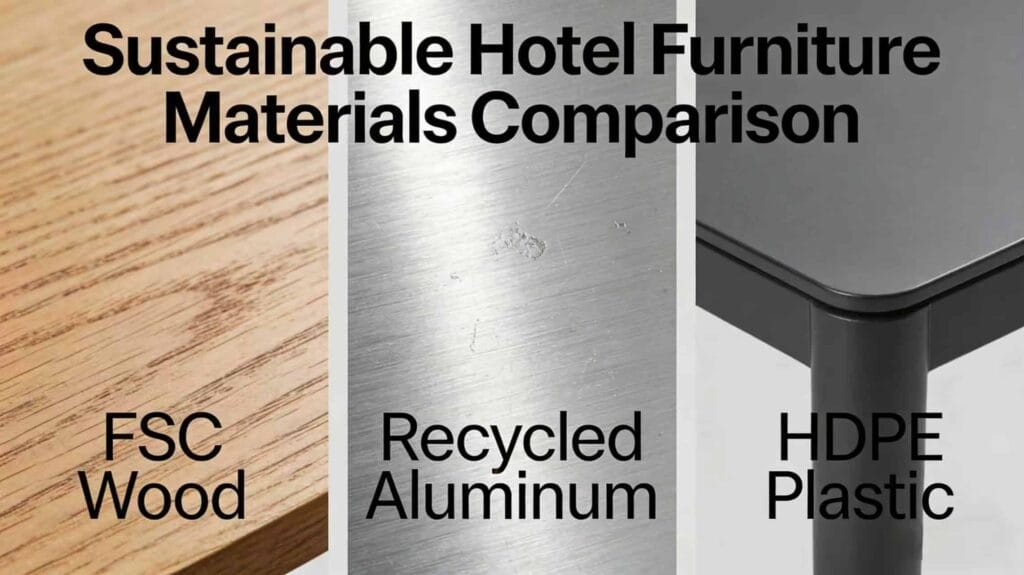
Material Performance Guide
| Material | Durability | Best Applications | What to Watch For |
| FSC-Certified Oak | 15-20 years | Desks, headboards, dressers | Requires proper finishing; avoid in high-humidity climates |
| Recycled Aluminum | 25+ years | Outdoor furniture, poolside seating | Powder coating quality varies; verify corrosion resistance |
| Post-Consumer HDPE | 20+ years | Outdoor tables, coastal properties | Color-fastness matters; cheap HDPE fades in 5 years |
| Reclaimed Wood | 10-15 years | Accent pieces, feature walls | Verify source; shipping distance impacts carbon footprint |
When sourcing custom Sustainable hotel furniture, material selection directly impacts both sustainability and longevity. Quality outdoor furniture should use marine-grade aluminum frames with UV-resistant powder coating rated for 10+ years in coastal environments. Generic “recycled aluminum” fails in 3 years at beachfront properties.
Details matter.
Part 4: How to Vet Suppliers (The 5-Question Test)
You’re evaluating vendors. They all claim sustainability. Here’s how to separate real from fake in under 10 minutes:
Question 1: “Email me your FSC certificate right now.”
Real suppliers send it within 2 minutes. It’ll have a certificate number you can verify at info.fsc.org.
If they say “Let me check with our team,” you’re dealing with a middleman who doesn’t have direct manufacturing oversight.
Question 2: “What’s the VOC emission rate on this finish?”
Look for Greenguard Gold certification with lab test results dated within the last 12 months. Generic claims like “low-VOC” without third-party testing are meaningless.
Quality suppliers use water-based finishes with VOC levels at 0.3 mg/m³ (Greenguard Gold requires <0.5 mg/m³) and include lab reports with every quote because transparency isn’t optional.
Question 3: “Where is this manufactured and can I visit?”
Vague answers like “we work with international partners” = red flag. Legitimate suppliers give you factory information and manufacturing transparency.
PMOU has its own furniture factory in China. All hotel furniture is custom-made, with strict quality control and flexible design options.
Question 4: “What happens to this furniture in 15 years?”
The best suppliers have buyback programs or disassembly instructions. They’re thinking circular economy, not just making a sale.
If they look confused, they’re selling you linear-economy products dressed up with green marketing.
Question 5: “Show me 3 completed hotel projects with contact references.”
Photos on a website prove nothing. Verified references from hotel GMs who’ll answer their phone on the second ring? That’s credibility.
Reputable suppliers provide client references for every proposal over $75K. No exceptions.
Part 5: The Regional Advantage (Why Location Matters)
Not all sustainable hotel furniture strategies work everywhere. Climate and regulations vary wildly.
Coastal Properties (Florida, California, Hawaii)
Salt air destroys cheap finishes. You need marine-grade powder coating on all metal components. HDPE plastic outperforms wood for outdoor seating.
Poolside collections should use 316-grade stainless steel hardware (not the cheaper 304-grade that corrodes) to withstand salt environments in coastal locations like Miami or Hawaiian resorts.
Mountain/Ski Resorts (Colorado, Utah, Vermont)
Extreme temperature swings wreak havoc on composite materials. Solid wood with proper sealants performs better. Look for furniture tested to -20°F.
Urban Markets (NYC, Chicago, LA)
LEED certification matters more here due to stricter building codes. Greenguard Gold certification is often mandatory for new construction. Budget 15% more for documentation and compliance.
Part 6: PMOU One-Stop FF&E Solution Advantage
For projects ranging from 50-500 rooms, working with an integrated FF&E (Furniture, Fixtures & Equipment) and OS&E (Operating Supplies & Equipment) provider offers distinct advantages:
Streamlined Procurement
Instead of managing multiple vendors for furniture, lighting, textiles, toiletries, and operational supplies, a comprehensive supplier can coordinate:
- Custom guest room furniture packages
- Lobby and public space furnishings
- Restaurant and bar furniture
- Complete OS&E from linens to amenities
Project Management Benefits
Experienced FF&E providers offer:
- Design coordination from concept to installation
- Sample approval processes with online tracking
- Consolidated global shipping and logistics
- On-site installation management
- Post-delivery support and warranty service
Cost Optimization
Centralized procurement through one supplier typically delivers:
- Consolidated shipping reducing freight costs
- Volume pricing across product categories
- Reduced administrative overhead
- Single point of contact for accountability
- Transparent project milestone tracking
Part 7: Custom vs. Ready-Made: Making the Right Choice
When Custom Makes Sense
Custom furniture is essential when:
- Your hotel brand requires specific design consistency
- You need unique dimensions for non-standard spaces
- Your concept demands distinctive styling
- You’re developing a boutique or luxury property
- Long-term brand differentiation is critical
When Ready-Made Works
Standard furniture solutions are appropriate for:
- Limited budgets with tight timelines
- Economy or midscale properties
- Renovations requiring quick turnarounds
- Projects under 30 rooms
The Hybrid Approach
Many successful projects use a strategic mix: custom pieces for high-visibility areas (lobby, signature suites) combined with quality ready-made furniture for standard guest rooms. This balances budget, uniqueness, and timeline.
Conclusion: Your Week 1 Action Plan
Stop researching. Start executing.
Monday: Email your current furniture supplier. Ask for FSC certificates on all 2025 purchases. If they can’t provide them within 48 hours, you’ve been buying unverified products.
Tuesday: Calculate your 10-year furniture replacement costs using the table above. Show it to your CFO. Let the ROI speak.
Wednesday: Request samples from certified suppliers. Not photos—physical samples. Touch them. Test them. Put coffee on them and see if it stains.
Thursday: Check if your state offers tax incentives for sustainable building materials. DSIRE (Database of State Incentives for Renewables & Efficiency) lists every program.
Friday: Schedule a factory tour or comprehensive supplier review. Virtual is fine. But understand where your furniture actually comes from and how it’s made.
Final Thoughts
Sustainable hotel furniture isn’t complicated. It’s just different. The suppliers who make it complicated are hiding something.
The suppliers who make it simple—who answer questions directly, provide documentation immediately, offer comprehensive FF&E and OS&E solutions, and stand behind their work with real references—those are the ones worth your time.
Ready to Upgrade Your FF&E Strategy?
PMOU specializes in custom hotel furniture and complete FF&E/OS&E solutions for hospitality projects worldwide.
Services Include:
- Custom furniture design and manufacturing
- Complete FF&E procurement (furniture, fixtures, equipment)
- OS&E supplies (linens, amenities, operational items)
- Global sourcing and logistics management
- Project coordination from design to installation
Contact: evelyn@pmou-int.com
Website: onestophotelffe.com
Phone: +86-566-2311810
From luxury resorts to boutique hotels, we deliver tailored solutions that combine craftsmanship, functionality, and sustainable practices for hospitality projects around the globe.