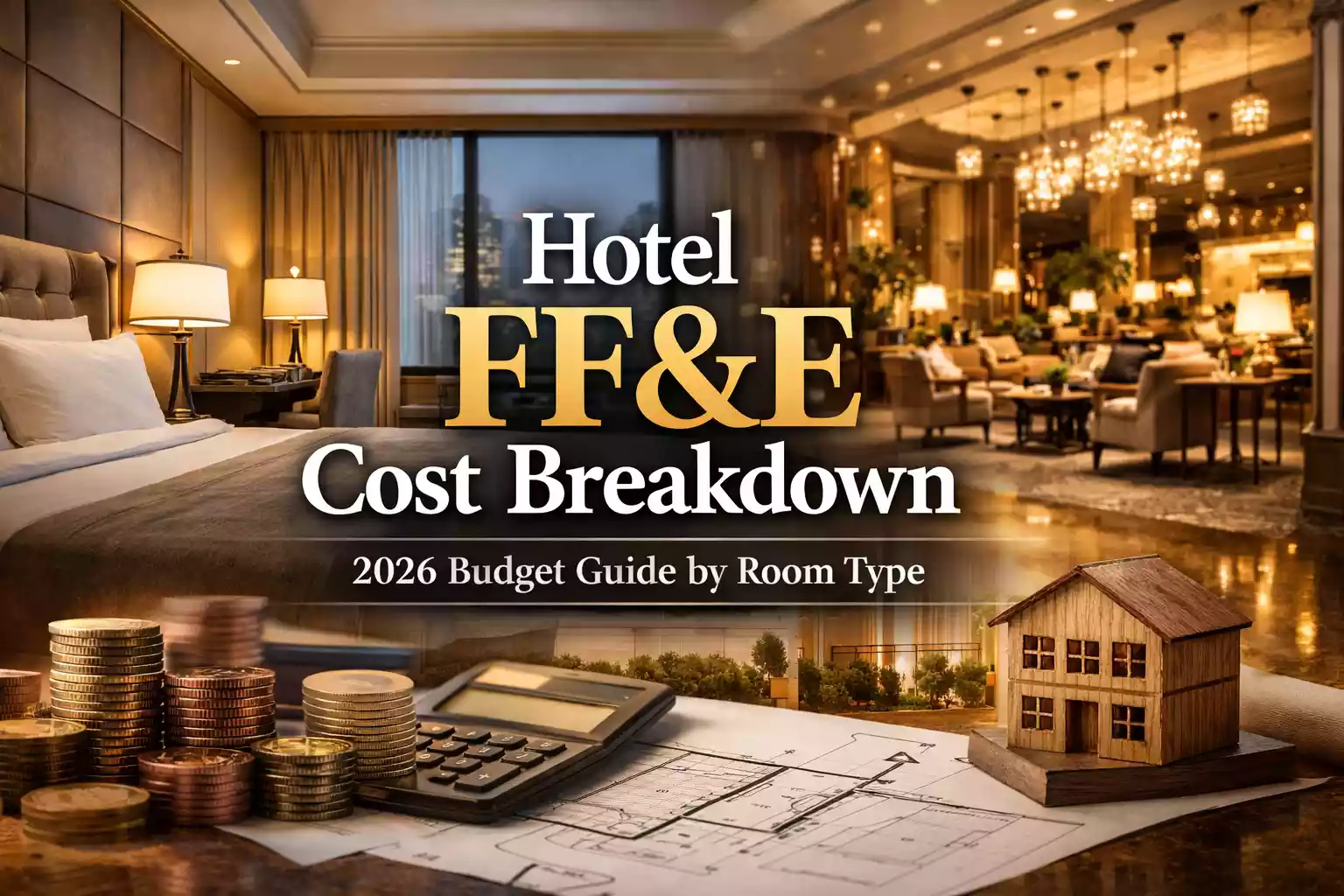
Hotel FF&E cost breakdown is one of the first things owners should understand before starting a hotel project, because FF&E can move a budget up or down very quickly. In 2026, hotel FF&E cost often starts around $4,000 per room for budget properties and can reach $60,000+ per room for luxury hotels. In many projects, FF&E takes about 8%–12% of total development cost. [Data source: HVS, 2025 U.S. Hotel Development Cost Survey]
If you are planning a hotel build or renovation, the real question is not just “What does FF&E include?” It is “How much will it actually cost, and where does the money go?”
This guide gives you the answer in a simple way, with room-by-room pricing first, then the cost details behind it.
Hotel FF&E Cost Per Room in 2026
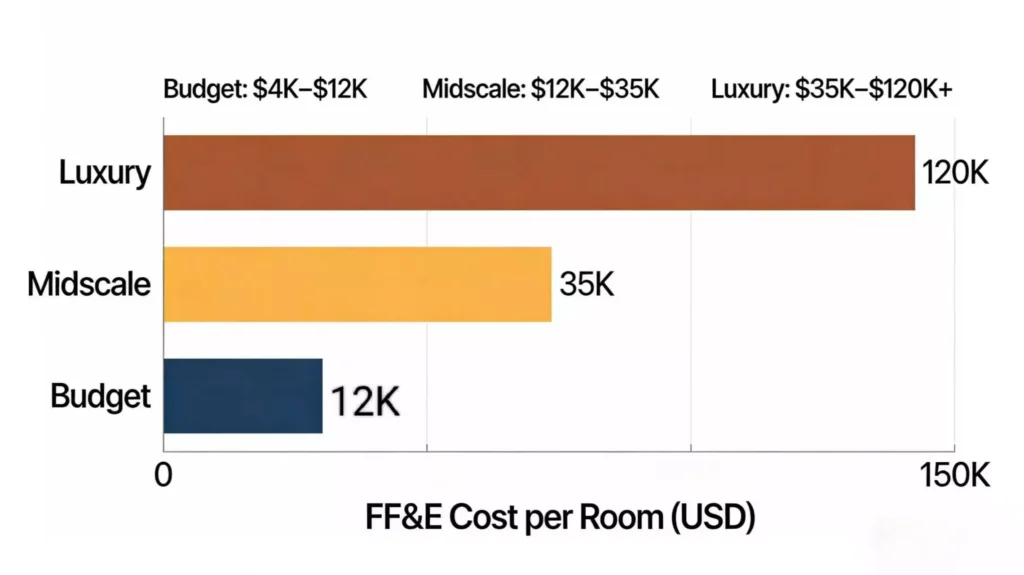
The fastest way to estimate hotel FF&E cost is by hotel type.
| Hotel Type | Typical FF&E Cost Per Room |
| Budget / 2–3 Star | $4,000–$12,000 |
| Midscale / Upscale | $12,000–$35,000 |
| Luxury / 5-Star | $35,000–$120,000+ |
These are practical planning ranges, not fixed prices. The final number depends on room size, material choice, design standard, and how much custom work is needed.
HVS’s 2025 U.S. Hotel Development Cost Survey reported a median total development cost of $167,048 per room for limited-service hotels, $409,513 per room for full-service hotels, and $1,057,494 per room for luxury hotels. That gap shows how strongly hotel class affects budget planning.
What Is Included in Hotel FF&E?
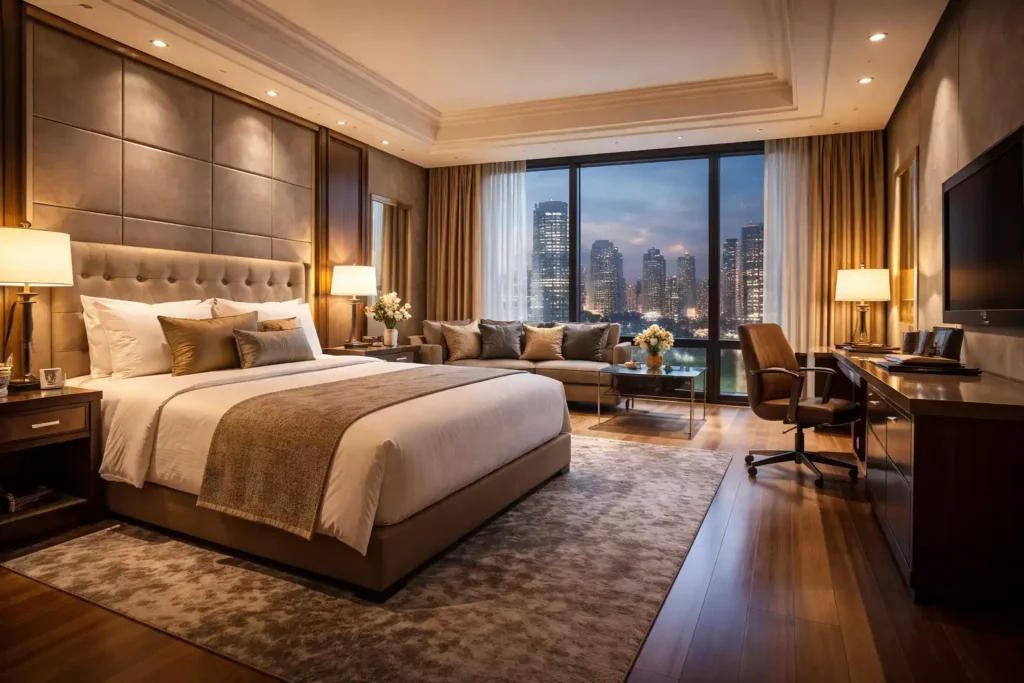
FF&E means Furniture, Fixtures & Equipment. In a hotel project, it usually includes movable items such as:
- Beds and mattresses
- Headboards
- Desks and wardrobes
- Nightstands and casegoods
- Chairs and sofas
- Lighting fixtures
- Mirrors and decorative items
FF&E does not include the building structure, and it is separate from operating supplies such as towels, linens, and consumables.
What Makes Hotel FF&E Cost Higher?
The biggest cost driver is customization.
Standard furniture is cheaper because it is easier to produce and source. Custom FF&E costs more because it requires design work, sample approval, special materials, and longer lead times.
Other major cost drivers include:
- Material grade
- Brand standards
- Room size
- Shipping and import cost
- Installation and labor
- Lead time pressure
A hotel with strong brand requirements will usually spend more than a hotel using standard solutions, even if the room count is the same.
Hotel FF&E Cost Breakdown by Category
Once you know the per-room budget, the next step is to split the money into categories.
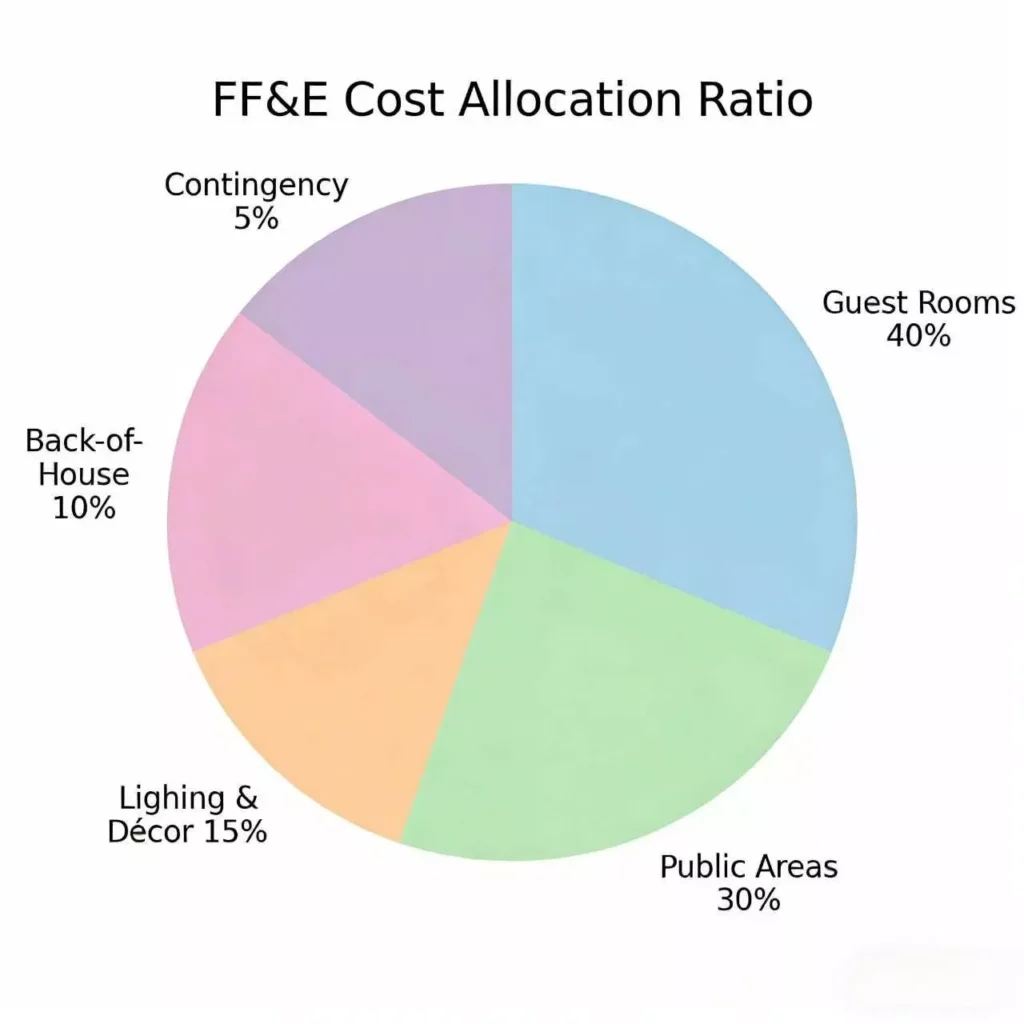
A common planning model looks like this:
- Guest rooms: 38%–40%
- Public areas: 25%–30%
- Lighting and décor: 10%–15%
- Back-of-house and misc.: 5%–10%
1. Guest Rooms
Guest rooms usually take the largest share of the FF&E budget because every room needs the same core items. This includes beds, mattresses, casegoods, seating, and in-room storage.
This category matters most because guest room comfort affects reviews, occupancy, and repeat bookings.
2. Public Areas
Public areas include the lobby, lounge, restaurant seating, reception desk, and other shared spaces.
Many hotel owners underestimate this part of the budget. In reality, public areas often need more design attention because they shape the first impression of the property.
3. Lighting and Décor
This category includes decorative lighting, artwork, mirrors, and other visual elements.
These items may not be expensive one by one, but they can create a noticeable cost increase when the design is customized across multiple spaces.
4. Back-of-House and Misc.
This includes staff areas, storage furniture, office furniture, and support equipment.
It is a smaller category, but it should never be ignored. If it is left out, the final budget will look lower than it really is.
Hidden FF&E Costs Most Projects Miss
The product cost is only part of the story.
In real hotel projects, hidden costs often add 20%–30% on top of the furniture and equipment price if they are not planned early. These costs usually include:
- Freight and shipping
- Import duties and customs handling
- Warehousing and storage
- On-site installation and assembly
- Damage replacement
- Project management
- Contingency reserve
HVS notes that hotel development budgets should be adjusted for inflation over time, and that many hotel projects take three to five years from planning to opening. That means procurement timing matters as much as unit price. [Data source: HVS, 2025 U.S. Hotel Development Cost Survey]
FF&E as a Share of Total Hotel Cost
A normal planning range is 8%–12% of total development cost, but luxury hotels can go above that.
A simple example:
| Total Project Cost | Estimated FF&E Budget |
| $20M hotel | $1.6M–$2.4M |
| $50M hotel | $4M–$6M |
| $100M hotel | $8M–$12M |
This is why FF&E should be planned early. If the total project cost changes, the FF&E budget usually changes too.
How to Reduce Hotel FF&E Cost Without Cutting Quality
There are four simple ways to keep FF&E cost under control.
1. Source Direct from Manufacturers
Direct sourcing can reduce middleman markup and improve communication.
2. Standardize Where Possible
Not every item needs to be custom. Standardize the parts that guests will not strongly notice.
3. Plan Procurement Early
Late orders usually mean higher shipping cost, rush fees, and fewer supplier options.
4. Bundle Purchasing
Buying in larger volumes usually improves unit pricing and helps control logistics cost.
Simple Real Example
Here is a simple planning example for a 100-room midscale hotel.
If the FF&E budget is $10,000 per room, total FF&E would be $1,000,000.
A possible split could look like this:
- Guest rooms: $400,000
- Public areas: $280,000
- Lighting and décor: $150,000
- Logistics and installation: $120,000
- Contingency: $50,000
This kind of breakdown gives owners a much clearer picture of where the money is going.
Final Insights on Hotel FF&E Cost Breakdown
Hotel FF&E cost breakdown shows it is not just a furniture number. It is a full budget system that includes design, sourcing, shipping, installation, and risk control.
The best hotel projects usually stay on budget because they define scope early, avoid unnecessary customization, and plan procurement before the timeline gets tight.
If you are planning a hotel project and need help with FF&E sourcing, quotation, or cost control, PMOU can help simplify the process and support a more accurate budget plan.
FAQ About Hotel FF&E Cost Breakdown
Q: How much does hotel FF&E cost per room?
A: Hotel FF&E cost usually ranges from $4,000 to $120,000+ per room, depending on hotel type, design standard, and customization.
Q: What is included in hotel FF&E?
A: Hotel FF&E usually includes beds, mattresses, headboards, desks, wardrobes, chairs, sofas, lighting, mirrors, and decorative items.
Q: What are the hidden FF&E costs?
A: Hidden FF&E costs often include freight, import duties, warehousing, installation, assembly, and contingency.
Q: How can hotels reduce FF&E cost?
A: Hotels can reduce FF&E cost by sourcing direct, standardizing design, planning early, and avoiding last-minute changes.
Q: What percentage of total hotel cost is FF&E?
A: FF&E usually accounts for 8%–12% of total development cost, though luxury projects can go higher.