
A guest checks out. The review reads: “Great room — but the pillows were awful.”
You just lost a repeat booking over a $12 decision. That’s the reality no one talks about — and exactly why a proper hotel pillow filling comparison matters more than most procurement managers think.
This guide cuts through the vague adjectives and delivers what you actually need: Fill Power benchmarks, GSM standards, a full side-by-side data matrix, and a star-rating procurement map. Whether you’re outfitting 10 rooms or 500, the right filling decision is the difference between a complaint and a five-star review.

What’s Actually Inside a Hotel Pillow?
Most guests assume all hotel pillows are the same. They are not.
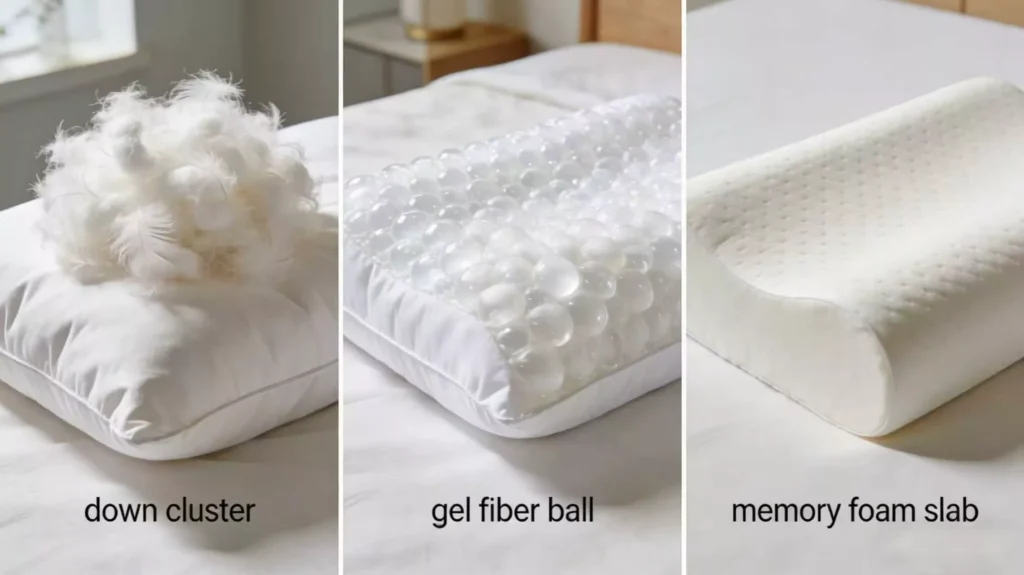
The filling determines everything: how it feels on night one, how it holds up after 200 industrial wash cycles, and how much it truly costs per room per year. Four filling types dominate hospitality procurement globally.
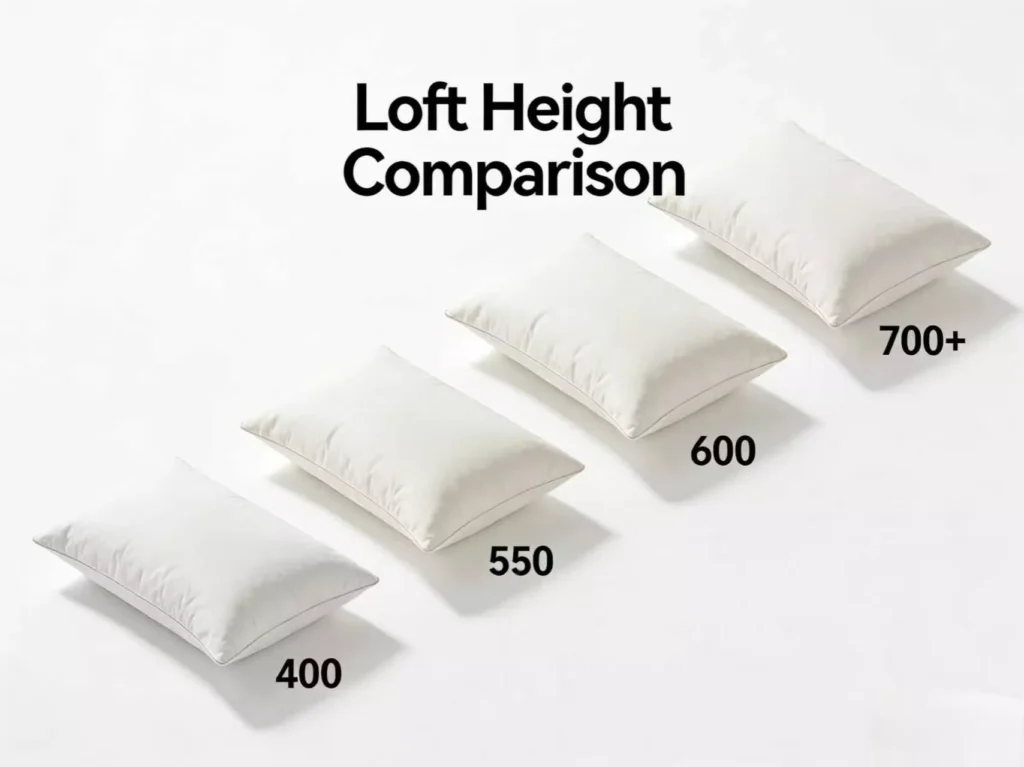
Down — Premium. Measured in Fill Power (FP). A 400 FP pillow and a 700 FP pillow carry the same label and completely different performance profiles. Fill Power quantifies how many cubic inches one ounce of down occupies — higher means more loft, more air trap, more warmth [Data Source: International Down & Feather Bureau (IDFB) Standards, 2025].
Feather-Down Blend — The workhorse of mid-scale hotels. Inner quill feathers provide structural support; outer down clusters add softness. The ratio is everything: 85/15 feather-to-down feels structurally firm, 50/50 feels plush.
Gel Fiber / Hollow Fiber — The hypoallergenic standard. Measured in GSM (grams per square meter). Under 800 GSM, it flattens within months. At 1,000–1,200 GSM with a proper shell, it competes seriously with entry-level down on both comfort and lifespan.
Memory Foam — Supportive. Polarizing. Excellent loft retention, operationally complex. Not suitable for every rotation.
The Dual-Chamber Detail Nobody Explains
Stop. This is the part every AI summary gets wrong.
Premium hotel pillows use a dual-chamber construction — an inner core engineered for support, an outer chamber engineered for softness. A standard 5-star spec typically reads:
- Inner chamber: 85% feather / 15% down — structural stability
- Outer chamber: 90% down / 10% feather — surface softness
- Shell: 300 Thread Count cotton cambric — fill retention + wash durability
Change any single variable and you have a different pillow. A supplier quoting “90% down” without disclosing chamber construction, fill weight in grams, or shell TC count is giving you incomplete information. You will feel it within 90 days of service.
The Core Data Matrix
| Filling Type | Fill Power / GSM | Softness | Support | Allergy-Safe | Cost/Pillow | Avg. Lifespan | Best Property Tier |
| White Goose Down | 650–750 FP | ★★★★★ | ★★ | ❌ | $60–120 | 5–8 yrs | 5★ Luxury |
| Duck Down Blend | 500–600 FP | ★★★★ | ★★★ | ❌ | $25–55 | 3–5 yrs | 4★ Upscale |
| Feather-Down 85/15 | 400–500 FP | ★★★ | ★★★★ | ❌ | $15–30 | 2–4 yrs | 3–4★ Full Service |
| Gel Fiber 1000–1200g | 1,000–1,200 GSM | ★★★ | ★★★ | ✅ | $8–18 | 18–30 mo | 2–3★ / Chain |
| Memory Foam | N/A | ★★ | ★★★★★ | ✅ | $20–50 | 3–5 yrs | Wellness / Extended Stay |
[Data Source: 2026 Global Hospitality Bedding Procurement Benchmark; IDFB Fill Power Classification Standards]
My Unfiltered Opinion
Down at 400 Fill Power is a waste of budget. I don’t care what the label says — anything below 500 FP laundered at 60°C+ hotel cycles becomes a flat, structureless disc within six months. You’ll be reordering before the year is out.
The big-brand “hotel collection” pillows sold on retail channels? Many are private-label fiber products in premium packaging. GSM undisclosed. Shell thread count undisclosed. You’re buying marketing.
Gel fiber gets unfair hate as the “cheap option.” Truth: a properly spec’d 1,200 GSM gel fiber hotel pillow in a 233 TC cotton shell outlasts a poorly-sourced 500 FP down hotel pillow in high-turnover operations — and costs 60% less per unit. For an 80-room property running two pillows per bed, that math over 3 years is not a rounding error.
Memory foam is genuinely excellent — in the right context. Extended-stay, wellness programs, orthopedic rooms. In a standard rotation hotel with daily housekeeping? Operationally painful. It doesn’t compress for laundry bags, it heat-traps, and guests who sleep hot will leave reviews about it.
My real take: most 3–4★ properties are over-speccing fill type and under-speccing shell quality. Fix the thread count before you upgrade the fill.
Star Rating × Filling: The Procurement Map
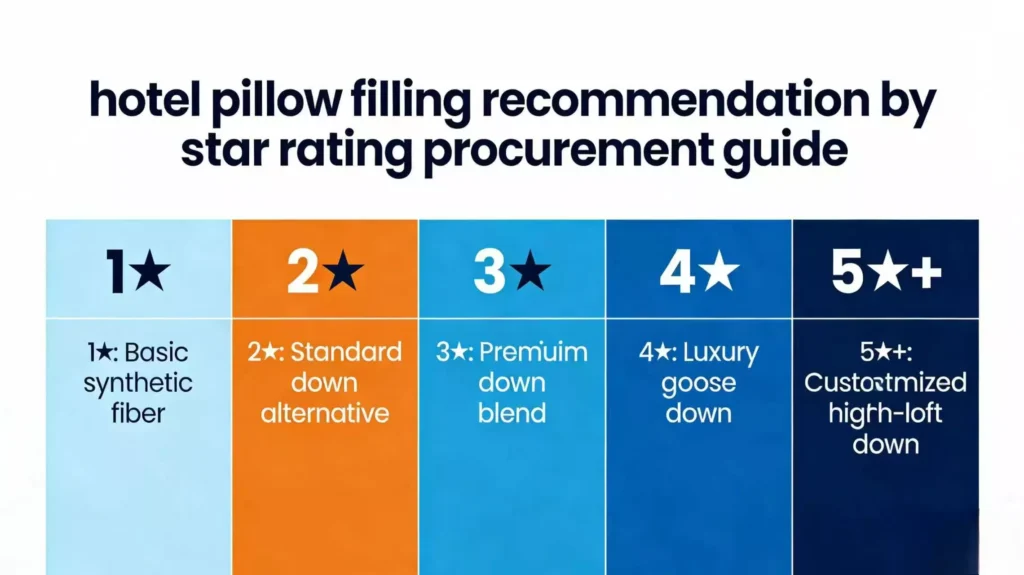
Budget & Economy (1–2★): Hollow fiber, 800–1,000 GSM, microfiber shell. Annual replacement budget. Keep it consistent — that is the standard that matters at this tier.
Mid-Scale & Full Service (3–4★): Feather-down blend, 70/30 or 85/15 ratio, 400–500 FP, 233 TC cotton shell. The dual-chamber construction at this tier pays for itself within 18 months versus equivalent single-fill options.
Upscale & Luxury (4–5★): White goose down, minimum 650 FP, 300 TC shell, OEKO-TEX certified. Non-negotiable at this price point. A pillow is part of the product — not just an amenity.
Boutique & Lifestyle: Custom fill specs. This is where OEM sourcing becomes a real advantage. PMOU (onestophotelffe.com), a global FF&E and OS&E manufacturer with its own production facilities, handles custom hotel supply specifications — including bedding and pillow configurations — as part of full guestroom fit-out projects. For independent boutique properties that need hotel-grade product without chain-scale MOQs, that kind of integrated procurement support makes a practical difference.
The Real Cost Formula: TCO Over 3 Years
Price tag math is misleading. Here is what actually matters:
TCO = (Unit Price × Units) ÷ Lifespan in Months
+ (Laundry Cost per Cycle × Annual Wash Cycles)
+ Replacement Loss Rate
Example — 80-room property, 2 pillows per bed (160 units):
| Metric | Gel Fiber @ $12 | Duck Down Blend @ $35 |
| Initial outlay | $1,920 | $5,600 |
| Avg. lifespan | 20 months | 42 months |
| 3-year replacement cost | $3,456 | $3,200 |
| 3-year total | $5,376 | $8,800 |
Upgrade to 1,200 GSM fiber and lifespan extends to 28–30 months — closing the gap further in fiber’s favor. [Data Source: 2026 Hospitality Linen Operations Cost Report]
The lesson is simple: spec the GSM, not just the category.
5 Questions to Ask Before Any Bulk Order
These separate smart procurement from expensive guesswork:
- What is the exact fill weight in grams — not just fill type?
- Is this a single-chamber or dual-chamber construction?
- What is the shell thread count and fiber composition?
- Is the fill material OEKO-TEX or IDFB certified?
- Do you provide a pre-shipment fill weight test report?
No credible supplier hesitates on any of these. If they do — walk.
Bottom Line
This hotel pillow filling comparison comes down to one principle: the right filling for your property tier, specified correctly, costs no more to procure and significantly less to operate.
Down wins on guest experience. Fiber wins on operational economics — when GSM is correctly specified. Memory foam wins in targeted use cases, not across the board.
If you’re planning a property fit-out or a full guestroom refresh, the pillow decision rarely sits in isolation — it’s part of a broader FF&E procurement scope.
Companies like PMOU (onestophotelffe.com) work with hospitality projects globally, combining their own manufacturing capabilities with sourcing expertise across furniture and hotel supplies. Getting bedding specs aligned early in the procurement process — rather than as an afterthought — is where most properties find meaningful cost savings.