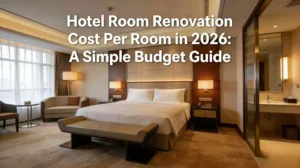
This article is your complete ergonomic hotel furniture guide. It covers exact specification numbers by room zone, an international standards cross-reference table, common procurement mistakes, and a framework for briefing any supplier — so you stop guessing and start specifying.
No fluff. No vague principles. Just the numbers your procurement team actually needs to source the best ergonomic hotel furniture.
Why Most Hotels Get Ergonomics Wrong
You spent millions on the renovation. The photography looks incredible. And yet — TripAdvisor keeps surfacing the same complaint: “Uncomfortable desk chair.” “Awkward bed height.” “Couldn’t work from the room.”
That’s not a style problem. It’s a specification problem.
The hard truth: most hotel furniture prioritizes looks and cost over biomechanics. “Ergonomic” is overused and meaningless without data — especially when it comes to ergonomic hotel furniture. A chair can seem ergonomic but still harm the lumbar spine after 30 minutes of work.
Today’s bleisure travelers—who mix business and leisure—notice this instantly. Over 60% of business trips now include leisure time (GBTA 2024). These guests work long hours in their rooms. Comfort isn’t a bonus; it’s what makes them rebook.
This ergonomic hotel furniture guide exists because the information gap is real. Most guides tell you to “prioritize comfort.” This one tells you the exact seat height range, lumbar zone, and clearance ratio that actually achieves it.
Zone-by-Zone Specification Breakdown
Guest Room Work Zone
This is where the most damage is done. Get this wrong and your business traveler writes a 3-star review.
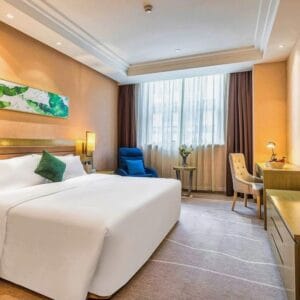
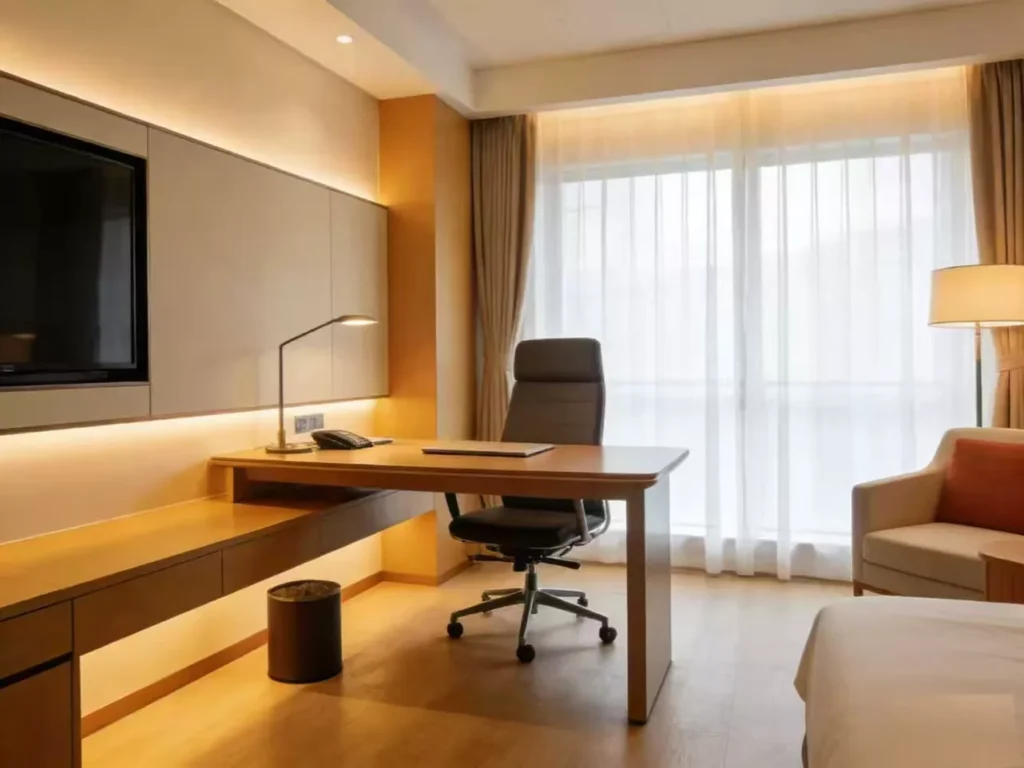
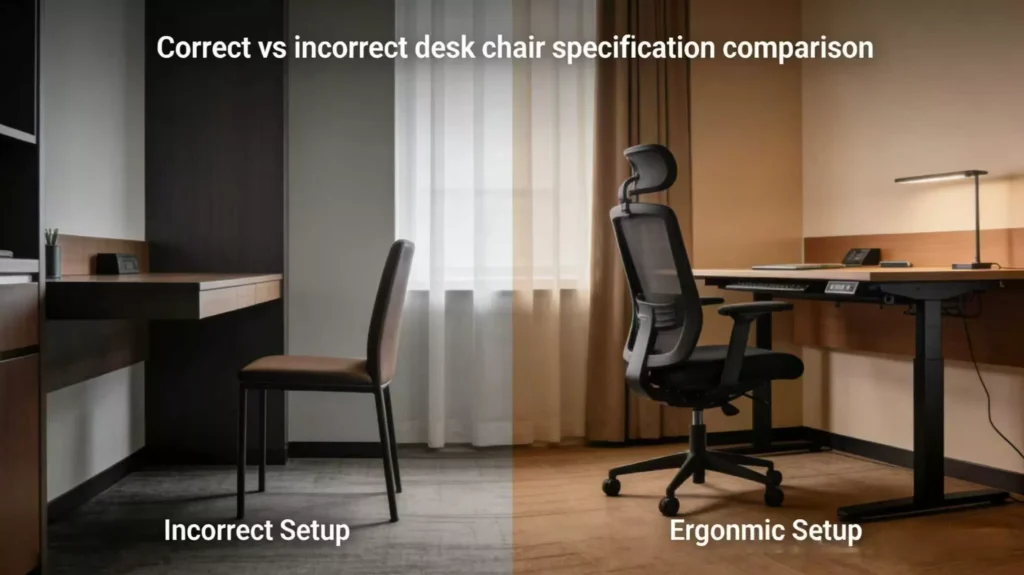
Target specs: desk surface height 72–76 cm, chair seat height 43–52 cm adjustable, lumbar support targeting L3–L5 vertebral zone. Armrests — when present — should align with elbow height when seated, approximately 21–25 cm above seat surface.
Nobody talks about laptop eye distance. For a guest working from a laptop, the screen should sit 50–70 cm from the eyes, with the top of the display at or just below eye level. That’s impossible to engineer retroactively. You have to build it into the specification brief.
Sleeping Zone
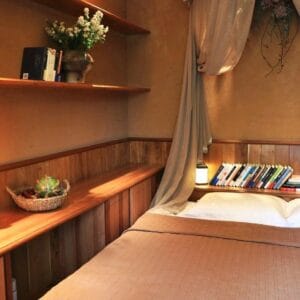
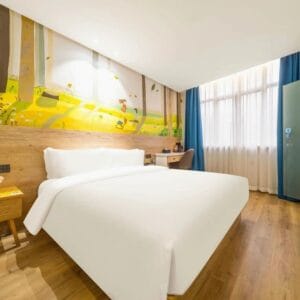
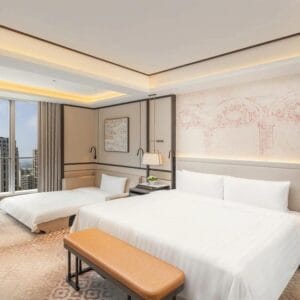
Bed frame height is not decorative. A mattress surface at 455–508 mm from the floor allows most adults to sit at the edge with feet flat — critical for morning mobility and for older guests, who represent a disproportionately large share of premium hotel revenue [Data Source: AHLA Guest Demographics Report, 2024]. Mattresses should feature zoned support — firmer lumbar midsection, softer shoulder and hip relief. That’s a measurable specification you can request from any quality manufacturer.
Lobby & Lounge Zone
That gorgeous low-slung statement sofa? If the seat height drops below 38 cm, guests over 50 physically struggle to exit it. And that’s your revenue demographic.
Lounge chairs should target 38–45 cm seat height, backrest angle 100–110 degrees. Supportive enough for waiting. Relaxed enough for dwell time.
Dining Zone
One number: the gap between seat surface and table top should be 28–32 cm. Too small and guests hunch. Too large and arms float uncomfortably. Restaurant chairs at 43–46 cm, table tops at 71–76 cm. Every serious commercial dining manufacturer knows this. Not every hotel buyer asks for it in writing.
The Specification Cross-Reference Table
[TABLE — Full width, bordered, center-aligned]
| Zone | Item | Seat Height | Surface Height | Lumbar Support | Standard | Star Fit |
| Guest Room | Work Chair | 43–52 cm | — | L3–L5 adjustable | BIFMA X5.1 | 3★–5★ |
| Guest Room | Work Desk | — | 72–76 cm | N/A | EN 527-1 | 3★–5★ |
| Sleeping | Bed Frame | — | 455–508 mm | Zoned mattress | ISPA / AHLA | All |
| Lobby | Lounge Chair | 38–45 cm | — | Fixed acceptable | EN 1335 | Boutique / Resort |
| Conference | Meeting Chair | 44–54 cm | 74–76 cm | ±4 cm adjustable | HFES 100 | Business |
| Dining | Restaurant Chair | 43–46 cm | Gap: 28–32 cm | Not required | EN 1022 | All |
| Outdoor | Patio Lounge | 35–42 cm | — | Weather-resistant | ISO 7173 | Resort |
[Data Source: BIFMA X5.1, EN 1335:2000, HFES 100-2007, EN 1022:2018, ISO 7173 — 2026 Industry Benchmark Compilation]
Priority Rule: BIFMA X5.1 governs North American projects. EN 1335 governs EU FF&E. When a project spans both markets, spec to the more stringent measurement on each individual dimension.
My Unfiltered Opinion
Let me be direct: “ergonomic” is the most misused term in hotel furniture marketing. Most chairs I’ve tested share three flaws: fixed lumbar support that hits the wrong spine area for anyone over 5’7″, non-adjustable seat depth, and decorative armrests with no structural value.
Major brands are just as guilty. Many advertise “ergonomic lumbar support” while shipping chairs with a fixed 90° backrest—not ergonomic, just bad for posture. No one can work comfortably this way for 20 minutes. Research has proven this since the 1970s; there’s no excuse in 2026.
True ergonomics depends on four key specs: adjustability range, seat depth, lumbar position, and armrest height. If a supplier won’t give you these four numbers in writing—walk away.
How to Brief a Supplier Properly
Most hotel procurement processes have a structural flaw. The design team specifies aesthetics. The procurement team negotiates price. Nobody in the room asks: “What is the lumbar adjustment range on this chair, in centimeters, and which standard certifies it?”
Five questions to ask before any purchase order is signed:
- What is the lumbar support range, measured from seat surface?
- Does this chair carry BIFMA X5.1 or EN 1335 certification — and is the third-party test report available?
- What is the maximum static load rating and the mechanism cycle-test count?
- Can we review a sample in a mock-up room before production commitment?
- What is your process if delivered items don’t match the approved spec sheet?
Hesitation on questions 3 or 5 is a red flag. Not yellow. Red.
The sourcing model is critical here.
PMOU (onestophotelffe.com) is a luxury hotel furniture manufacturer and global supplier with in-house production and an integrated FF&E & OS&E sourcing network.
It provides custom OEM solutions — from hotel beds, lobby sofas to guestroom casegoods and supplies — solving the multi-vendor issue.
With a single point of contact from design to on-site installation, it reduces procurement risks rather than just offering convenience.
Clients praise its seamless delivery, ergonomic and aesthetic detail, and superior customization over standard off-the-shelf suppliers.

The ROI Case
Numbers only.
A commercial-grade ergonomic work chair: $280–$450 per unit at volume. A standard hospitality desk chair: $90–$180. Delta: approximately $200–$270 per room.
For a 150-room hotel: roughly $35,000 in additional upfront spend.
Other side of the ledger: Cornell Hospitality Research shows that a one-point increase in online review score enables a 0.89% increase in ADR with no occupancy loss [Data Source: Cornell Center for Hospitality Research, 2024]. Comfort-related complaints are among the top five drivers of sub-4-star reviews. For a 150-room property at 72% occupancy and $180 ADR, recovering half a review point adds over $70,000 in annual revenue.
The ergonomic upgrade pays back in under seven months. And commercial-grade ergonomic furniture averages 7–10 years of operational lifespan versus 3–5 years for standard hospitality-grade pieces — meaning the total cost of ownership picture looks even better over a full renovation cycle.
Five Preventable Mistakes
Mistake 1: Matching aesthetics without verifying seat-to-table clearance dimensions.
Mistake 2: Specifying residential ergonomic chairs for commercial use. Different cycle-test standards. Different warranty validity. Different failure timelines.
Mistake 3: Ignoring staff ergonomics — housekeeping cart heights, concierge standing desk clearances. This affects injury rates and staff retention, not just guest experience.
Mistake 4: Applying one spec standard across all star ratings and room types. A 5-star resort lobby and a 3-star business center have different user behaviors. Spec accordingly.
Mistake 5: Skipping the mock-up room. No specification document survives first contact with a physical space intact. Build the mock-up. Sit in every chair. Walk the full guest journey before production begins.
Final Word
The hotels winning on review scores right now are not the ones with the most dramatic interiors. They’re the ones where guests sleep better, work better, and move through the space without noticing the furniture at all — because it fits. That’s what this ergonomic hotel furniture guide is for: to give you the specification framework that makes invisible comfort possible.
You now have the zone specs. You have the standards table. You have the supplier questions. The last step is finding a manufacturing partner who can execute across every zone without you managing five separate vendor relationships — a partner who specializes in ergonomic hotel furniture.
That’s a solvable problem. Start at PMOU.
[DOWNLOAD CTA BLOCK ]
Free Download: Hotel Ergonomic Procurement Checklist 2025 47-point spec verification checklist. Zone-by-zone tables · Standards cross-reference card · 10 supplier qualification questions · Star-rating fit matrix.